How Does Nuclear Waste Disposal Keep Us Safe?
Have you ever seen green glowing slime in cartoon shows? Many people believe used nuclear fuel looks like that. In real life, it does not. Real fuel is made of solid metal rods [1, 2]. Did you know that eighty-seven percent of fresh fission fragments turn stable in just one month 6? Most trash from power stations is very ordinary. It is paper, cloth rags, and tools from work rooms [1, 2]. Government agencies strictly regulate nuclear waste disposal to protect human health and the environment 1. Still, locking away the hottest waste remains a major technical task that scientists study closely 4.
Think of it like this
Think of nuclear fuel like wood logs burning inside a village chulha stove. Burning wood makes heat to boil sweet chai. Soon, only hot coals remain. You do not touch hot embers with bare hands. You let them cool in an iron pot. After that, you store the cold ash far away. Used nuclear fuel simply needs time to cool down before long-term storage [1, 2].
Where does nuclear waste come from?
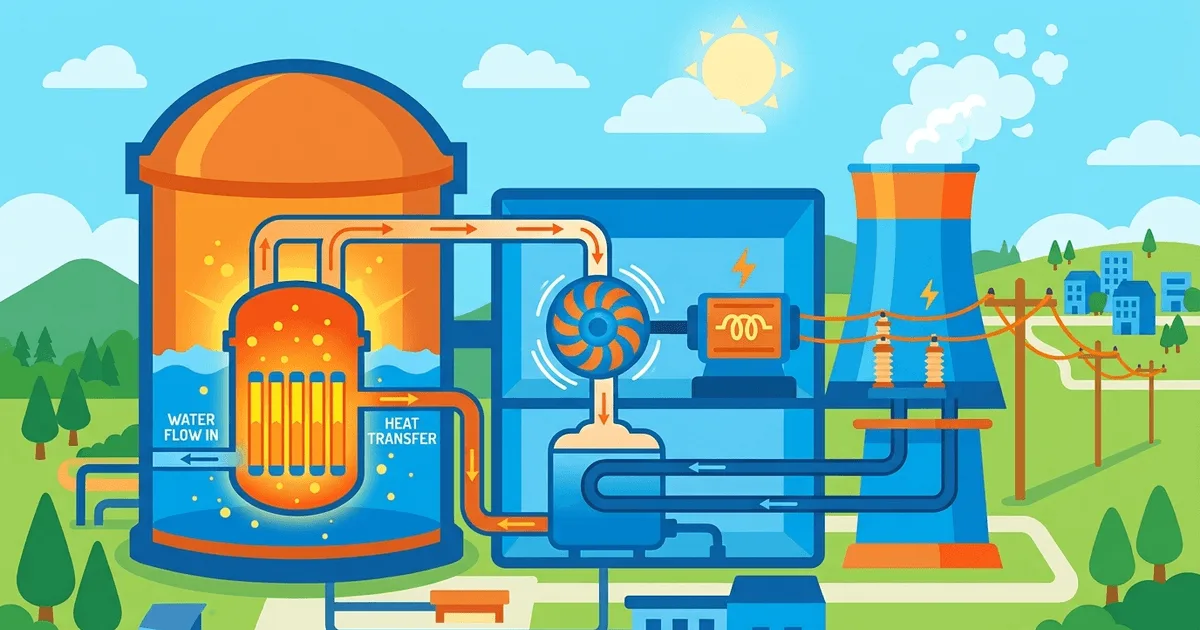
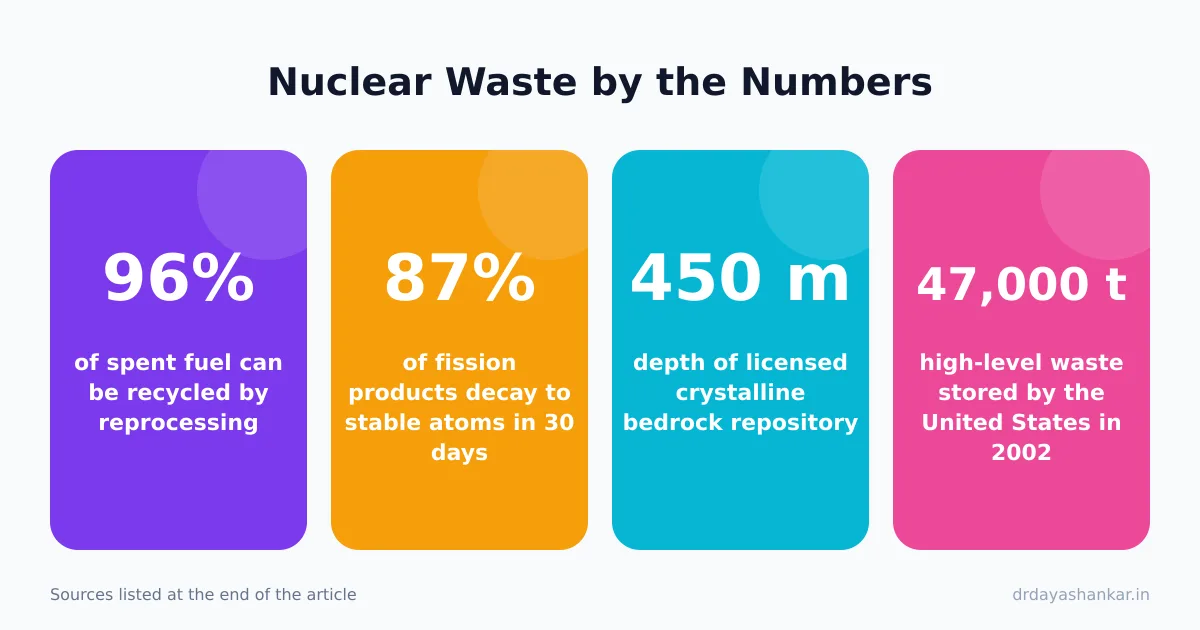
Every power plant leaves some waste behind. Coal plants leave huge heaps of dark ash. When reading about how nuclear power plant works, we learn that uranium atoms split [1, 6]. This splitting makes heat for clean electric power [1, 6]. The reaction leaves behind used fuel rods [1, 2]. Hospitals also use radioactive materials to treat and test patients [1, 2]. Experts sort this waste into three main piles 1. The first pile is low-level waste 1. It includes paper, cleaning rags, tools, and clothing 1. Low-level waste holds small amounts of mostly short-lived radioactivity and is stored on or near the surface for the short term 1. The second pile is intermediate-level waste, which contains higher amounts of radioactivity and needs shielding 1. The third pile is high-level waste 1. This is used fuel from inside the reactor [1, 2]. It is hot from decay heat and needs cooling and shielding 1. In 2002, the United States stored about 47,000 tonnes of high-level waste 3. Strict global rules govern this material 1.
Why is used fuel hot and full of energy?
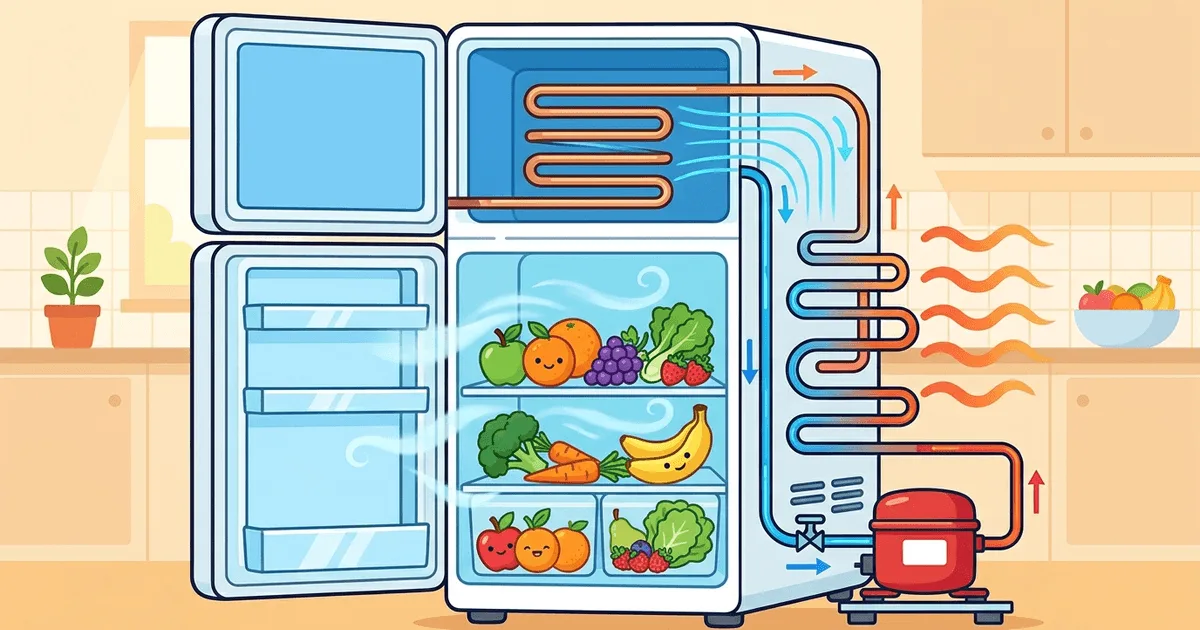
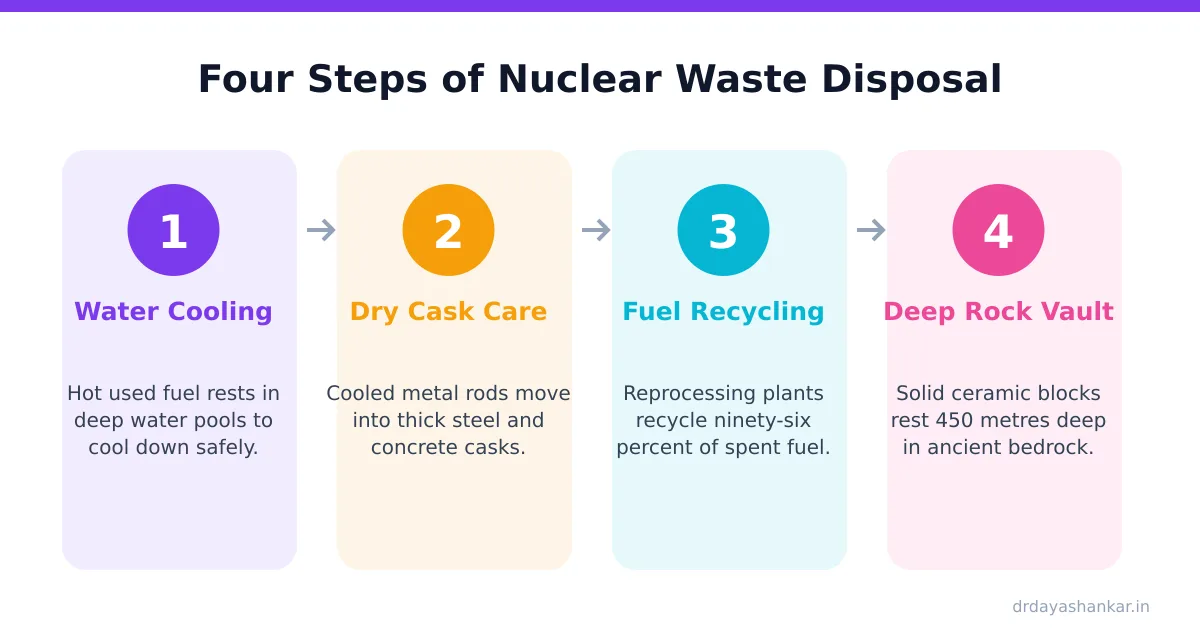
Inside a power plant, uranium atoms split in two 6. Scientists call these broken halves fission products 6. At first, these broken pieces are very unstable 6. They want to settle down and become calm 6. To reach a stable state, they shoot out unseen rays called radiation [1, 6]. Think of a fast cricket ball that slows down as it rolls across grass. These restless pieces create decay heat as they break down [1, 6]. That is why used fuel rods go into deep water pools [1, 6]. The water cools the rods and shields the room [1, 6]. Radioactivity weakens over time following a steady rule called a half-life [1, 3]. A half-life is the time needed for half the unstable atoms to decay 1. Rays from slow-decaying atoms are much less intense than rays from fast-decaying atoms [1, 3]. In fact, eighty-seven percent of fission products decay into stable atoms within thirty days 6. This natural drop helps engineers handle the fuel safely [1, 6].
Can we recycle used fuel instead of throwing it away?
Many people think used fuel is useless trash. In truth, used fuel holds lots of valuable power 1. Through a chemical method called reprocessing, plants recover useful material 1. With nuclear reprocessing, ninety-six percent of spent fuel can be recycled into new fuel 1. Plants across the globe have already reprocessed one third of all spent fuel 1. Only four percent stays behind as waste 1. This residual part holds fission products and minor actinides 1. Plants convert these leftover wastes into a glass-like ceramic 1. This conversion locks the waste inside a solid matrix for deep storage 1. Before deep burial, cooled fuel can sit in dry cask storage 2. These dry casks are large cylinders made of concrete and steel 2. Each cask holds ten or more metric tons of high-level radioactive waste 2. Reading is nuclear power safe facts shows how engineers keep this fuel secure [2, 5]. Reprocessing turns most used fuel into fresh energy 1.
What is new in 2026?
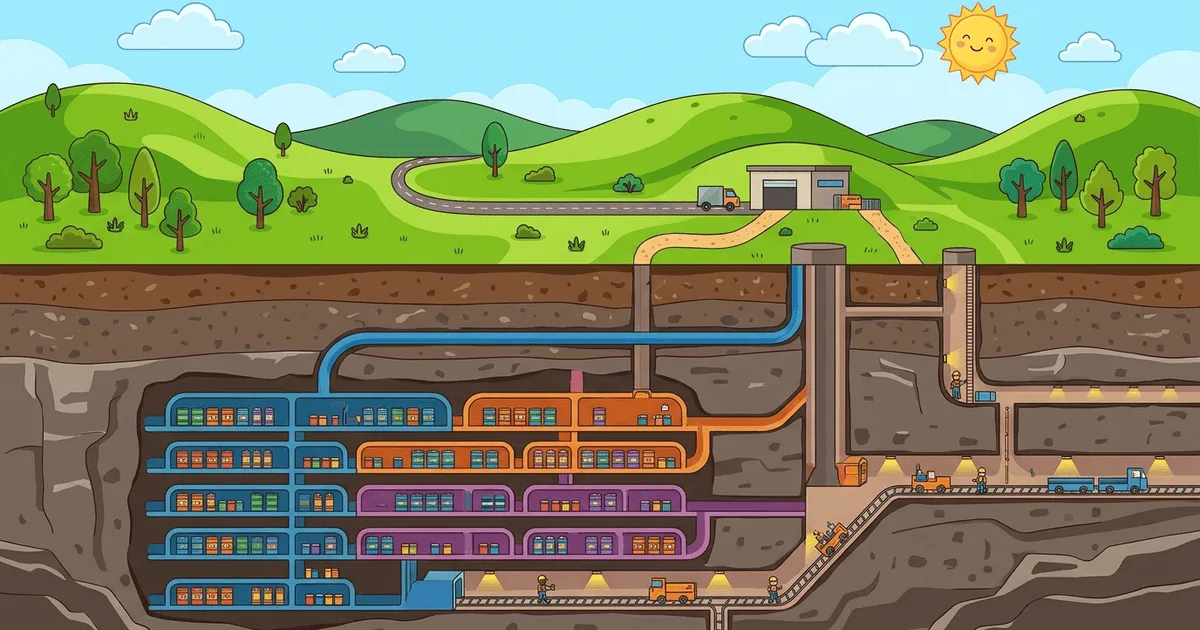
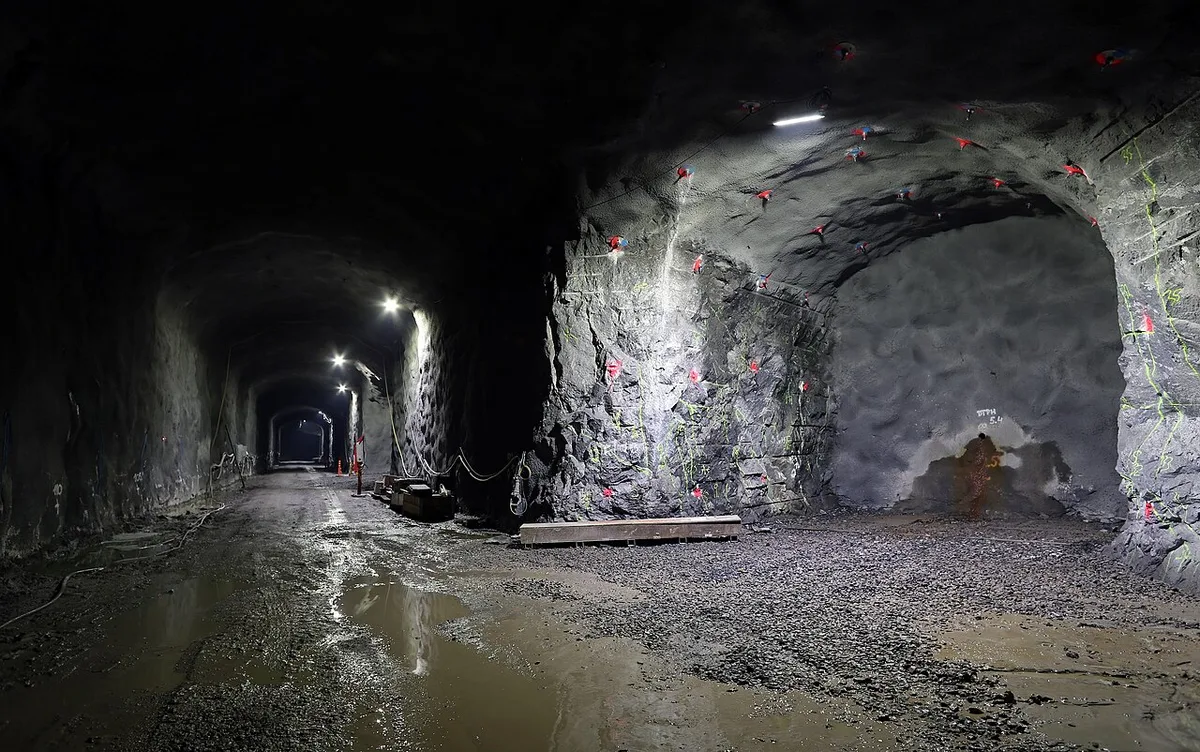
For many years, countries searched for permanent underground storage vaults. A historic milestone arrived in late 2026. In October 2026, the Finnish Government and their safety agency STUK approved the operating licence for Posiva Oy's Onkalo repository [8, 9, 10, 11]. Onkalo is the first permanent facility licensed to store spent nuclear fuel [8, 12]. The underground facility sits approximately 430 to 450 metres deep in crystalline bedrock 12. Inside this deep vault, spent fuel rests safely inside thick copper canisters for up to 100,000 years 12. Other countries made key progress in 2026 as well. In October 2026, Germany's disposal company BGE narrowed its prospective geological repository search from twenty-five percent to less than five percent of the nation's land 10. These steps mark a major global turning point [8, 10]. Safe deep geological disposal is no longer just an idea on paper [8, 12]. It is now an approved, licensed reality in solid rock [8, 12].
Why does safe disposal matter for everyday life?
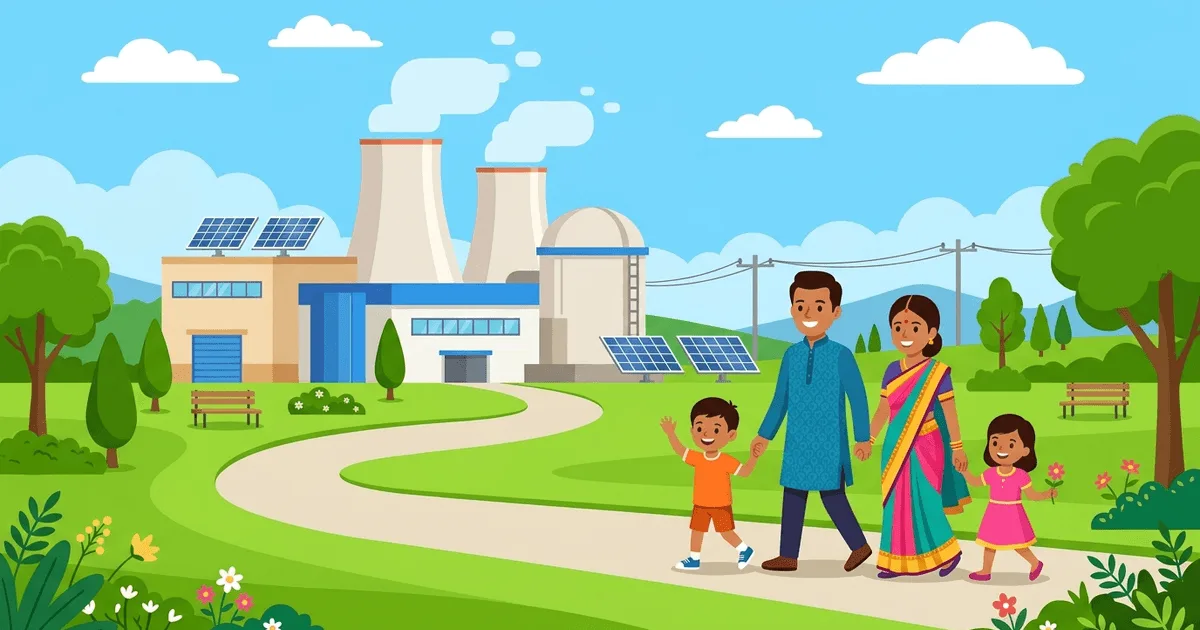
Electricity powers our daily routines across India. It spins our ceiling fans, runs local trains, and charges our mobile phones. Nuclear stations supply steady electricity without dark smoke [1, 6]. Reading a nuclear fusion explained simple guide helps us look forward, but our reactors need careful management today [1, 4]. Reprocessing lets us recycle ninety-six percent of used fuel into fresh energy 1. For the remaining high-level waste, scientists favor deep geological repositories [1, 4]. Excavating tunnels 500 to 1,000 metres underground isolates waste far from people 3. Safe permanent disposal protects future generations so they do not carry the burden of our power waste 3. Storing solid glass-like ceramic inside bedrock protects our drinking water and soil for millennia [1, 2, 7]. Careful engineering, strong barriers, and independent checks make sure clean energy keeps us safe [1, 4, 7].
Key takeaways
- Low-level waste consists of everyday items like paper, rags, and tools that carry small amounts of radioactivity 1.
- Eighty-seven percent of fresh fission products decay into stable atoms within the first month 6.
- Nuclear reprocessing allows ninety-six percent of spent fuel to be recycled into new reactor fuel 1.
- Dry cask storage holds ten or more metric tons of waste in steel and concrete cylinders 2.
- In October 2026, Finland approved the operating licence for the world's first deep rock repository [8, 12].
Words to know
- Radionuclide
- An unstable atom that decays and gives off ionizing radiation 1.
- Half-Life
- The time it takes for half of the unstable atoms in a sample to decay 1.
- Fission Products
- The smaller atomic pieces formed when a large nucleus like uranium splits [1, 6].
- Nuclear Reprocessing
- A chemical process that recycles ninety-six percent of spent fuel into fresh energy 1.
- Geological Repository
- An underground vault built deep in solid rock to isolate waste permanently [1, 3, 4].
Frequently asked questions
Is nuclear waste a glowing green liquid?
No, used fuel is solid metal, not a liquid [1, 2]. Cartoons often show nuclear waste as glowing green slime. In reality, leftover waste from reprocessing is converted into a glass-like ceramic 1. Solid ceramic does not leak, melt, or wash away into underground water.
How long does used fuel stay radioactive?
Radioactivity fades over time following the half-life rule [1, 3]. Eighty-seven percent of fission products decay into stable atoms within thirty days 6. Long-lived isotopes take thousands of years to decay, but their radiation is far less intense [1, 3]. Deep rock vaults keep them isolated from living things [3, 4].
Can earthquakes break an underground repository?
Deep repositories sit 430 to 1,000 metres deep inside ancient rock formations [3, 12]. Deep underground rock moves much less than ground at the surface during earthquakes. Thick metal canisters packed tightly inside solid bedrock stay safe and shielded from surface shaking. The rock absorbs vibrations safely.
Why do we not shoot nuclear waste into space?
Launching rockets carrying radioactive waste into space is far too risky. If a rocket failed during launch, it could scatter radioactive material into our atmosphere. Storing waste deep under natural rock on Earth is far safer, steady, and dependable. Deep rock provides a quiet home without launch dangers.
Sources and how this was researched
Every fact above is linked to one of these sources. Numbers in boxes (like 1) point to the list below. Photo: kallerna / CC BY-SA 4.0.
- Radioactive waste. Wikipedia.
- Radioactive waste. Simple English Wikipedia.
- High-level radioactive waste management. Wikipedia.
- Jens Birkhölzer, James E. Houseworth, Chin‐Fu Tsang. Geologic Disposal of High-Level Radioactive Waste: Status, Key Issues, and Trends. Annual Review of Environment and Resources (2012).
- Nuclear fission product. Wikipedia.
- Finland Grants Operating Licence for World’s First Deep Repository (October 2026):** The Finnish Government an. cleanenergywire.org (2026).
- Situated approximately 430–450 metres deep in crystalline bedrock, it is the first permanent facility licensed. youtube.com (2026).