How Does a Refrigerator Cool Food and Drinks?
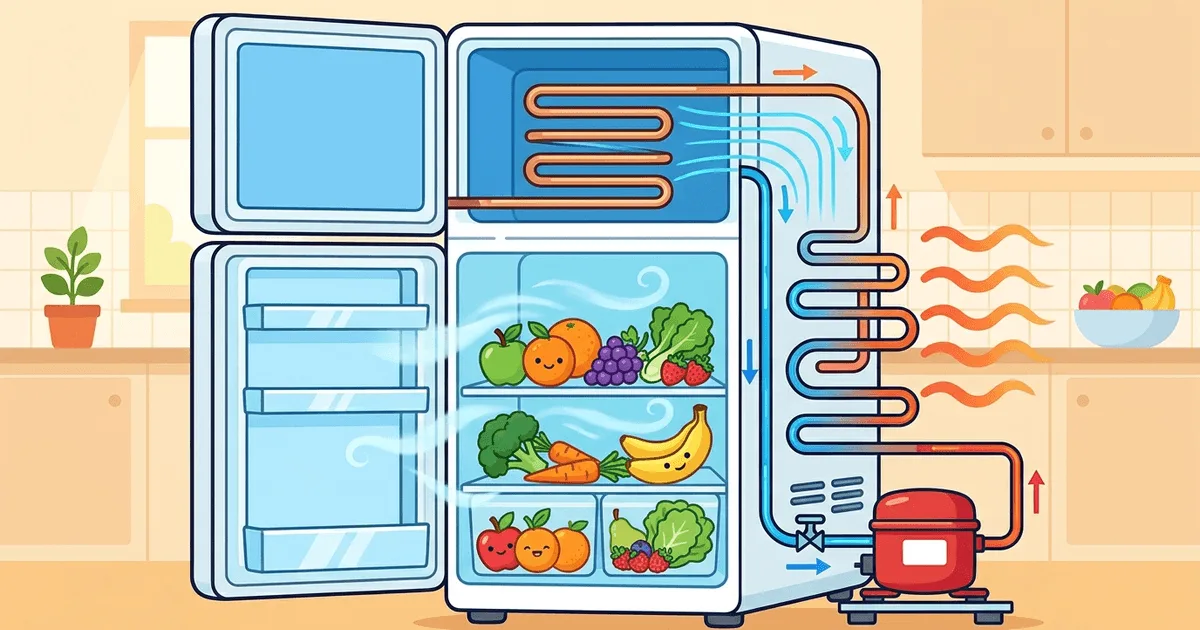
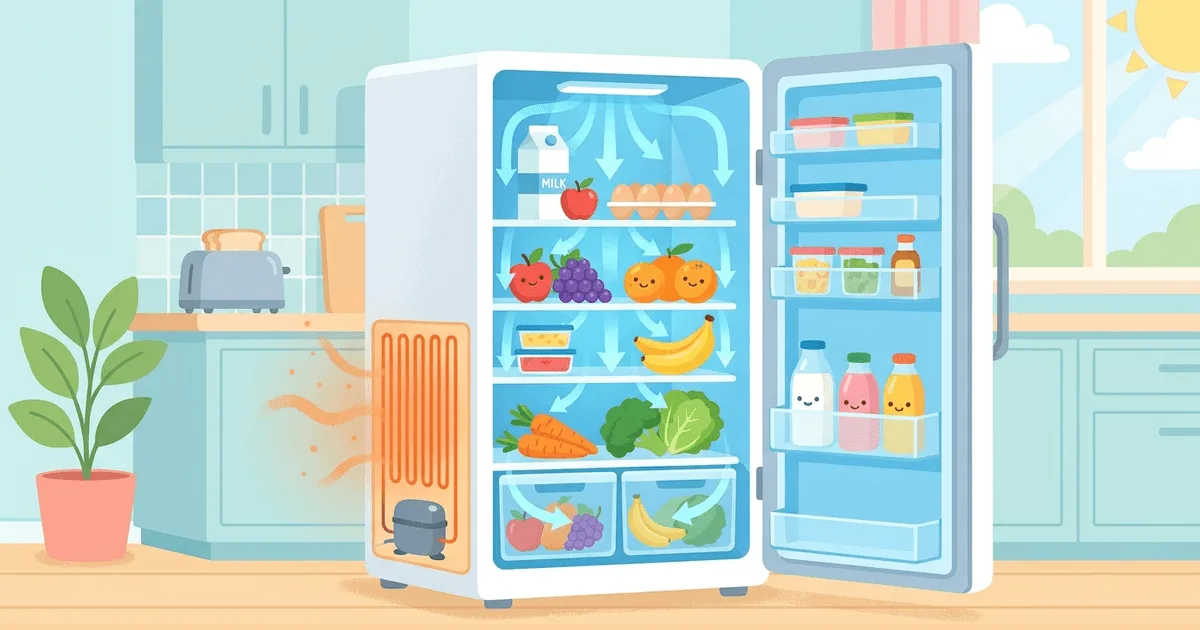
Touch the back of your fridge while it runs. It feels warm to your hand. You opened the door to get cold water or sweet mango lassi. Yet the metal outside feels hot. Why? Here is a neat secret of physical science. Your fridge does not make cold air from scratch 1. In science, cold is not a substance you can add to a box. Cold is simply what remains when thermal energy is taken away. So, how does a refrigerator cool food and drinks? It steals heat from food inside [1, 2]. Then it pushes that trapped heat into your kitchen [1, 2].
Think of it like this
Think of your kitchen fridge as a sponge for heat. Picture a spill of warm chai on a table. A dry sponge soaks up that liquid right away. You carry the wet sponge to the sink. Then your hand squeezes the liquid out down the drain. A refrigerator behaves just like that sponge [1, 2]. A circulating fluid soaks up heat from your groceries [1, 2]. It carries that energy away [1, 2]. Then it squeezes the heat into your kitchen air [1, 2].
Does a fridge make cold air from nothing?
No cooling machine can create cold out of thin air. In physics, heat is real energy from moving atoms. Cold is simply our everyday word for when heat is gone.
Think about stepping out of a bath under a spinning ceiling fan. Water drops on your warm skin dry up and turn into vapor. This change of liquid into vapor is called evaporation. To turn into gas, water steals warmth from your skin. That loss of thermal energy makes you shiver. Your home fridge relies on this exact principle of heat transfer [1, 2].
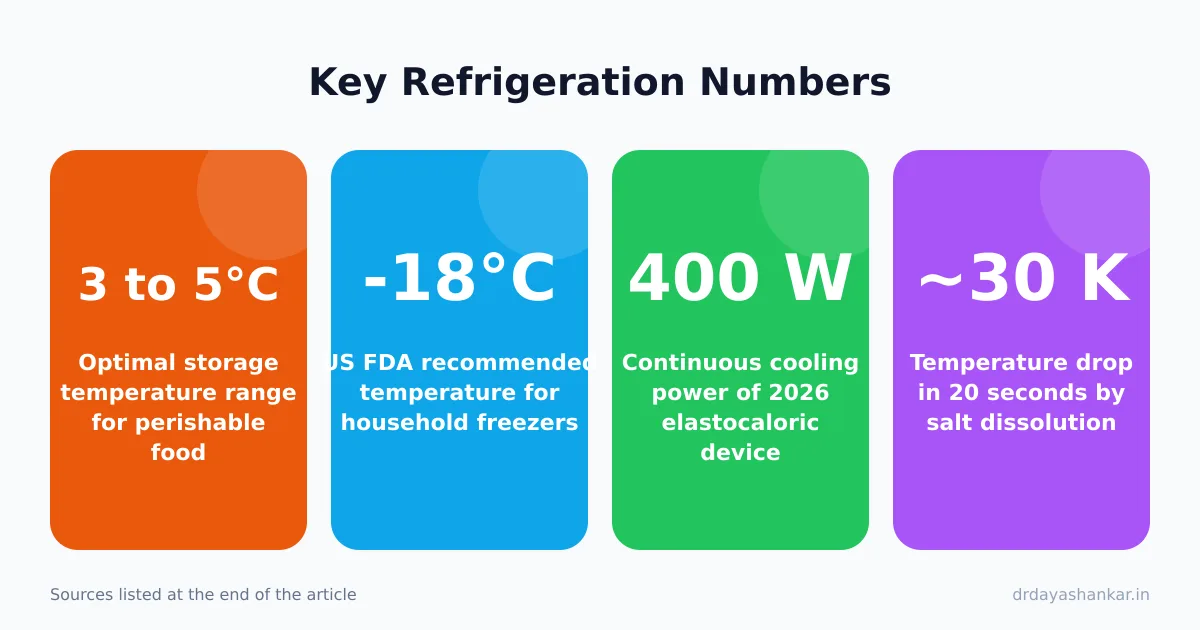
A modern fridge is an insulated box joined to a heat pump [1, 3]. A heat pump moves heat from colder spaces to warmer spaces [1, 2]. In nature, heat flows from hot bodies to cold bodies. A heat pump drives that flow backward 2. It pulls heat out of a cold space and expels it outside [1, 2]. It holds food safely between 3 and 5 °C 1. Read our guide on how refrigerator works to explore this system.
How does the cooling liquid pull heat from food?
Inside the cabinet walls runs a continuous loop of sealed metal pipes [1, 2]. A working fluid called a refrigerant travels through these tubes 2. A refrigerant is a liquid engineered to boil at very low temperatures. It switches between liquid and vapor states with great ease 2.
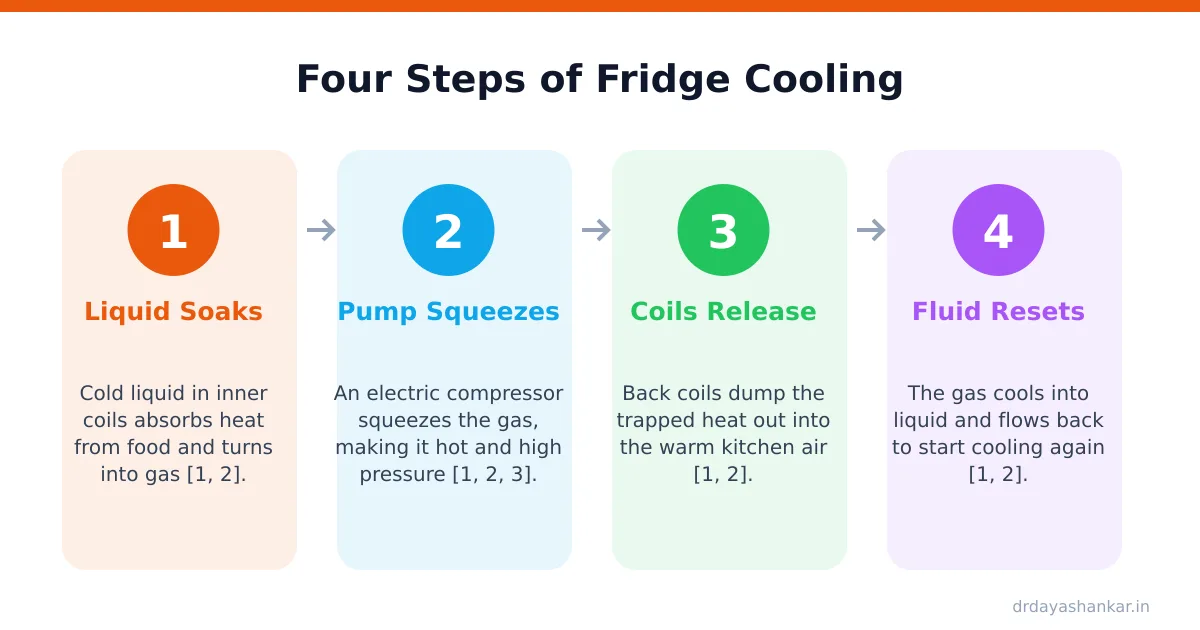
Heat naturally travels toward colder zones. When you place warm dal or fruit on the shelf, heat moves toward the colder pipe walls [1, 2]. The cold fluid running inside drinks up this warmth 2.
When it absorbs that heat, the cold liquid boils into a gas 2. When any substance shifts between liquid and gas states, scientists describe the step as a phase change 2. A boiling liquid swallows a lot of heat without getting hotter right away. In 1755, William Cullen showed this effect by boiling ether under vacuum to produce ice 1. Inside your fridge, this turning fluid traps food heat inside circulating vapor [1, 2]. Chilling food stops bacteria from reproducing, keeping meals fresh 1.
How do the compressor and coils dump heat outside?
Now the circulating gas holds all the thermal energy taken from your groceries 2. To chill the cabinet further, that heat must leave [1, 2]. An electric pump called a compressor rests at the bottom back of the fridge [1, 3].
The compressor squeezes the incoming vapor into a small volume [1, 2]. Squeezing a gas drives its molecules tightly together. This hard squeeze raises its pressure and makes the gas much hotter [1, 2]. This compression acts like hot air compression inside a vehicle, as explained in how car engine works.
Next, the hot gas flows into outer metal pipes called condenser coils. These external coils function like a car radiator 2. Because the gas inside is warmer than room air, heat radiates away into the room [1, 2]. As it sheds heat, the gas condenses back into liquid 2. In 1834, Jacob Perkins built the first closed vapor compression refrigeration machine 1. Modern refrigerators rely on this reliable cycle 1.
What is new in refrigeration in 2026?
In 2026, researchers engineered solid-state cooling mechanisms that eliminate chemical refrigerants entirely [4, 6]. These innovative designs prevent greenhouse gas leaks from warming the planet during daily food storage 4.
In September 2026, a research team led by Prof. Qingping Sun at Hong Kong University of Science and Technology revealed a zero-degradation elastocaloric cooling device [4, 5]. Instead of compressing gas, it bends and relaxes a shape-memory metal alloy made of titanium, nickel, copper, and cobalt 4. The device demonstrated a continuous cooling power of 400 W and held a 41 K temperature span across 1,000,000 operational cycles without degradation 4.
In August 2026, scientists at Karlsruhe Institute of Technology and the University of Tsukuba created an elastocaloric system powered by solar heat or waste heat without using electricity 6. In January 2026, researchers at the Chinese Academy of Sciences used reversible salt dissolution in water to produce a 30 K temperature drop in 20 seconds with 67 J/g cooling capacity at approximately 77% thermodynamic efficiency 7.
Why does reliable food chilling matter so much in India?
Keeping food fresh is critical across India because tropical summer heat causes quick food decay. Long ago, ancient people in India produced thin ice sheets by setting shallow earthen jars on flat roofs at night 2. The passing night breeze evaporated some water and cooled the rest.
Warm room air helps bacteria grow fast on milk, cooked rice, and vegetables. Lowering storage temperatures between 3 and 5 °C curtails microbial reproduction and lowers spoilage rates 1. This simple chilling protects food taste and stops troublesome tummy bugs. The United States Food and Drug Administration recommends operating refrigerators at or below 4 °C 1. It advises keeping home freezers regulated at -18 °C 1.
Refrigeration also safeguards vital vaccines in rural primary health centres. In my teaching career, detailed in About Dr. Daya Shankar, I explain how basic thermodynamics protects human life. A domestic refrigerator prevents household food waste and protects community health across millions of Indian homes [1, 2].
Key takeaways
- A refrigerator does not generate cold air; it extracts heat and exhausts it outside [1, 2].
- A special cooling fluid absorbs food heat and evaporates inside internal evaporator tubes [1, 2].
- An electric compressor squeezes vapor to high pressure so external coils can discharge heat [1, 2, 3].
- Keeping perishables between 3 and 5 °C limits bacterial growth and retards food spoilage 1.
- Groundbreaking 2026 solid-state alloys generate cooling power without relying on greenhouse refrigerant gases 4.
Words to know
- Refrigerant
- A specialized working fluid that carries heat by changing between liquid and vapor states 2.
- Heat pump
- A mechanical system that transfers thermal energy from a colder space to a warmer space [1, 2].
- Compressor
- An electric motor pump that compresses vapor to elevate its pressure and temperature [1, 2, 3].
- Phase change
- The physical transition of a substance between solid, liquid, and gas forms 2.
- Condenser coils
- External metal radiator tubes that release absorbed heat into the surrounding ambient room air [1, 2].
Frequently asked questions
Why does the outer body of my refrigerator feel warm?
A refrigerator cools food by moving heat into your room air [1, 2]. A circulating fluid absorbs warmth from the food inside 2. Outer condenser coils then dump that heat into the kitchen [1, 2]. This continuous heat release makes the outer cabinet warm to the touch [1, 2].
What is the optimal temperature for household food storage?
The optimal temperature range for perishable food storage is 3 to 5 °C 1. The United States Food and Drug Administration recommends keeping fridges at or below 4 °C 1. Maintaining these temperatures slows bacterial reproduction and keeps milk, vegetables, and cooked dishes wholesome for much longer 1.
Can leaving the refrigerator door open cool my kitchen?
No, an open refrigerator will actually warm your room [1, 2]. A refrigerator is a motorized heat pump [1, 3]. It extracts heat from the cabinet and exhausts it out the back [1, 2]. Both the removed heat and the motor heat stay trapped in your room [1, 2, 3].
What temperature should a home freezer maintain?
A home freezer must maintain temperatures below the freezing point of water 1. The United States Food and Drug Administration recommends setting freezers at -18 °C 1. Most household freezers operate between -23 and -18 °C to store frozen foods safely over extended periods [1, 3].
Sources and how this was researched
Every fact above is linked to one of these sources. Numbers in boxes (like 1) point to the list below.
- Refrigerator. Wikipedia.
- Refrigeration. Wikipedia.
- September 2026 (Hong Kong University of Science and Technology):** A research team led by Prof.. coolingpost.com (2026).
- August 2026 (Karlsruhe Institute of Technology & University of Tsukuba):** Researchers developed the first hea. kit.edu (2026).
- January 2026 (Chinese Academy of Sciences):** Researchers at the Institute of Metal Research (CAS), led by Pro. cas.cn (2026).