How Does a Car Engine Work? Simple Science Guide
Did you know a surprising fact about early motor cars? In the early 1900s, only around one fourth of all cars used internal combustion 3. Many early motor cars ran on steam or battery power 3. Today, most cars burn liquid fuel inside metal chambers to move people and goods 2. You turn a key or push a start button. Metal parts begin moving up and down with great speed. How does a tiny drop of fuel push a heavy family car? Controlled fires burn inside metal cylinders [1, 2]. Let us explore how car engine works in simple words.
Think of it like this
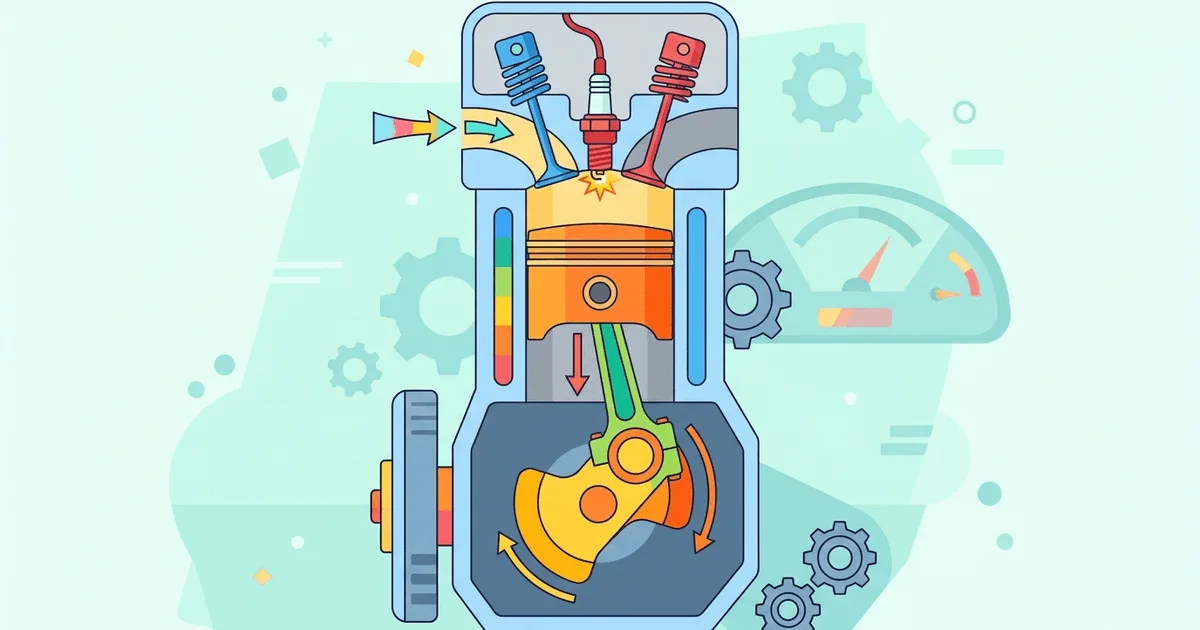
Think of riding a bicycle down your street. You push your foot down on the pedal. The pedal turns an iron arm called a crank. That spinning arm turns the bicycle wheel. In a car, expanding hot gas acts like your pushing foot [1, 2]. A tiny fire creates high pressure 1. This gas pushes a metal piston down [1, 2]. The piston turns a crankshaft to roll the wheels 1.
What happens inside a car engine when it starts?
An engine is a machine that changes energy into useful motion 5. Think of a pressure cooker on your stove. When water heats up, trapped steam builds strong pressure inside the cooker. Steam engines work in a similar way by using heat made outside the machine 1. In older days, steam engines pulled heavy trains and boats 5. But a car works in a different way. A car engine is an internal combustion engine 1.
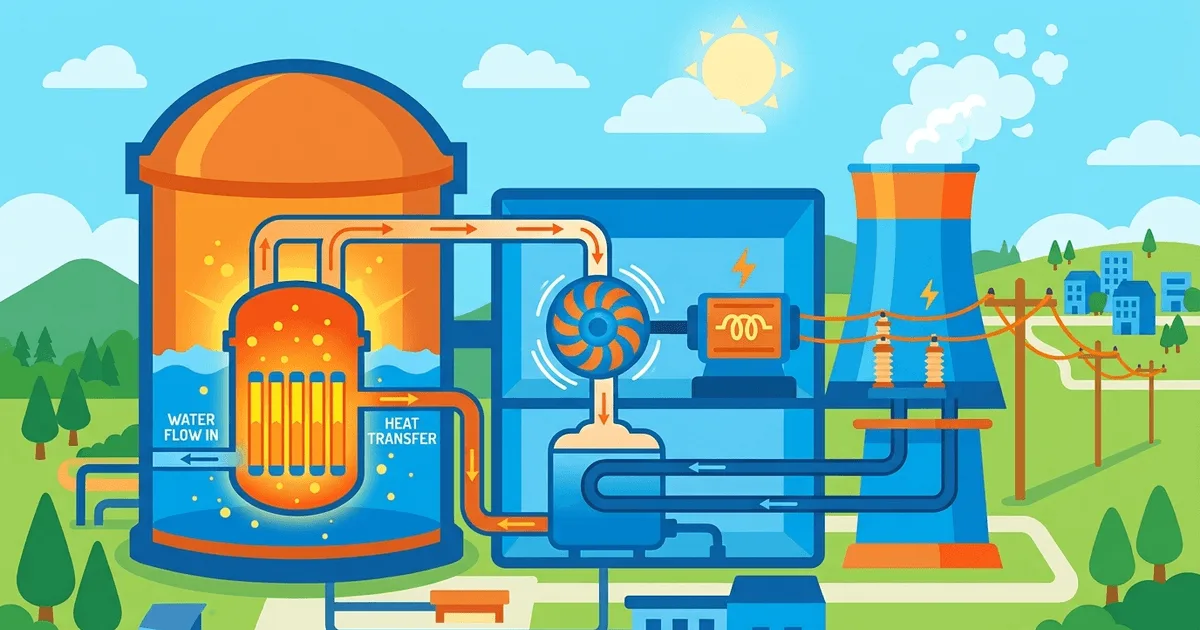
In this machine, fuel burns directly inside closed metal cylinders [1, 2]. Burning fuel creates very hot gases that expand quickly 2. This gas pushes hard against a sliding metal plug called a piston [1, 2]. The word engine comes from an old Latin word meaning clever skill [2, 5]. The engine turns chemical energy in fuel into kinetic energy to move your car 2. You can learn how heat makes power in our guide on how nuclear power plant works.
What are the four strokes of an engine cycle?
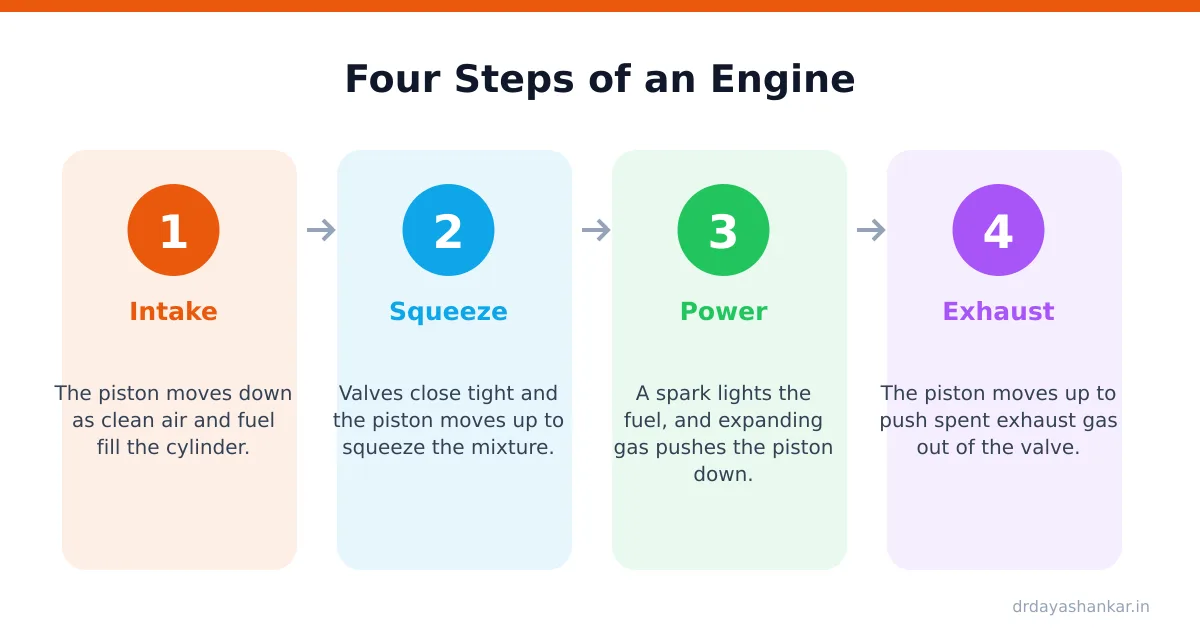
Modern petrol cars rely on a repeating cycle to turn fuel into wheel power. Nicolaus Otto patented this four-cycle engine in 1876 2. In a four-stroke engine, cylinders make power once every two turns of the engine 5. A stroke is one move of the piston up or down inside its cylinder. Four main stages work together to make the engine turn [1, 5].
- Intake: The piston slides down the cylinder while fresh air and fuel flow inside.
- Compression: Valves shut tight while the rising piston squeezes the mixture into a tiny space.
- Combustion: A spark plug makes an electric spark [1, 4]. The fuel burns, and expanding gas pushes the piston down [1, 2].
- Exhaust: An exit valve opens so the rising piston pushes burned gas out into the exhaust pipe.
Modern cars use a computer to set spark timing with high precision 4. These cycles repeat rapidly every minute. To learn how computers think, read what is artificial intelligence really.
Why do petrol and diesel engines work differently?
Petrol and diesel engines burn their fuel in two different ways. Most petrol engines use spark ignition to run 4. An electric battery sends power to make a hot spark in each cylinder 1. That tiny spark lights the fuel mixture [1, 4]. Petrol engines can be arranged in straight lines or V shapes [1, 4]. In a V engine, pistons sit in two angled rows to save space under the bonnet.
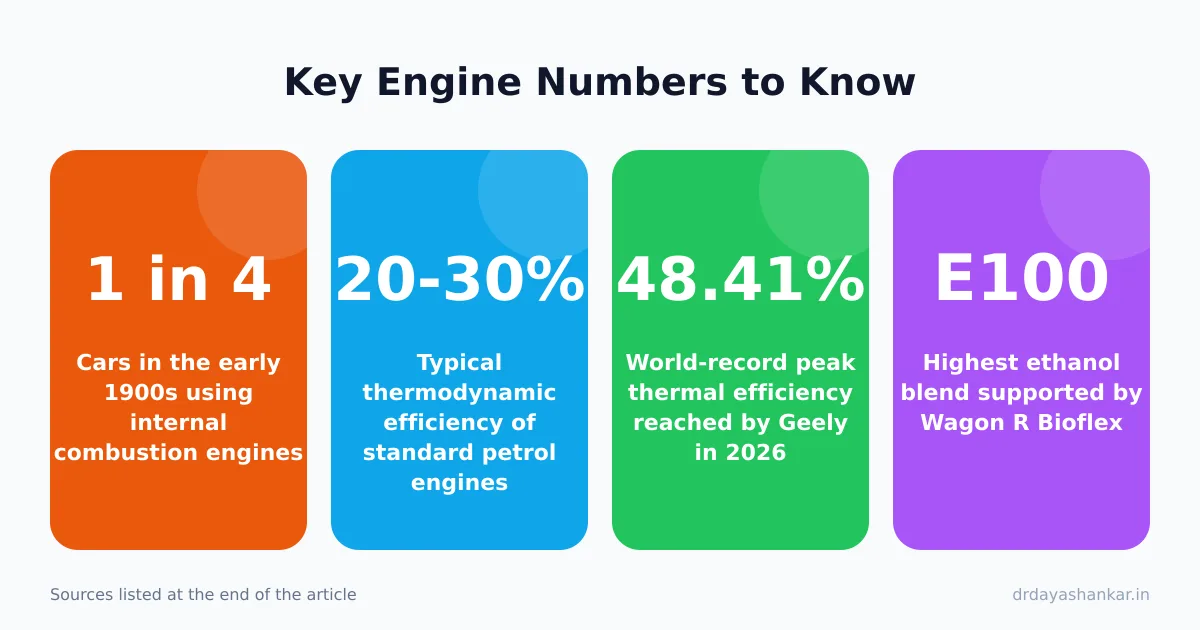
Diesel engines do not need a spark plug to burn their fuel 1. In 1892, Rudolf Diesel invented this new compression ignition engine 2. A diesel engine burns fuel by squeezing air until it is very hot [1, 3]. The piston squeezes the air so hard that fuel burns the moment it sprays in [1, 3]. In 1900, Rudolf Diesel even ran his engine using peanut oil 2! Petrol engines squeeze air much less than diesel engines do 4. Standard petrol engines turn only 20% to 30% of fuel heat into movement 4. Both designs give cars reliable power for highway travel [1, 2].

What is new in 2026?
Car engine science saw major new records in 2026. Standard petrol car engines reach only 20% to 30% thermal efficiency 4. In April 2026, Geely revealed its next-generation i-HEV powertrain 6. It uses high-tumble combustion and an AI-managed split-cooling system 6. Geely achieved a certified world-record peak thermal efficiency of 48.41% 6. This breakthrough system reached an ultra-low fuel consumption rating of only 2.22 litres per 100 kilometres 6.
Larger hybrid engines also set new high marks. On May 22, 2026, Dongfeng Motor Corporation received official testing certification for its 2.0-litre turbocharged hybrid engine 8. It reached a peak thermal efficiency of 45.5% 8. That set a top benchmark for large two-litre hybrid engines 8. In June 2026, Maruti Suzuki launched the commercial-spec Wagon R Bioflex in India 9. Its 1.2-litre engine uses fuel heaters and new sensors to run on any fuel blend from E20 to E100 9. These breakthroughs prove that traditional engines are becoming cleaner and more frugal.
Why do these car engine advances matter for India?
Millions of cars, autorickshaws, and buses run across Indian roads daily. Hot weather and crowded traffic test these machines hard. When an engine has high efficiency, it gets more mechanical push from every drop of fuel [2, 4]. Burning fuel cleanly is also vital because of increasing concern about exhaust gas emissions 3.
Flexible fuel brings big benefits to our country. In June 2026, Maruti Suzuki launched the Wagon R Bioflex with an ethanol concentration sensor 9. Bioethanol comes from plant crops and can power spark ignition engines. It blends smoothly with regular petrol [2, 4]. Starting modern cars is also much simpler than in early times. An electric starter motor engages the engine flywheel automatically 1. Drivers no longer need to turn a dangerous hand crank 3. Better efficiency saves fuel money and keeps our city air cleaner.
As a nuclear physicist and university dean, I enjoy teaching these heat principles to curious students. Read more on About Dr. Daya Shankar.
Key takeaways
- An internal combustion engine burns fuel inside cylinders to create mechanical motion [1, 2].
- A four-stroke engine makes power once every two turns of the engine 5.
- Petrol engines use electric sparks, while diesel engines ignite fuel through extreme compression [1, 4].
- In April 2026, Geely achieved a world-record peak thermal efficiency of 48.41% 6.
- Maruti Suzuki launched the Wagon R Bioflex in June 2026 to run on fuel up to E100 9.
Words to know
- Internal Combustion Engine
- An engine where fuel burns inside closed chambers to make pressure and power [1, 2].
- Piston
- A sliding metal plug pushed inside a cylinder by expanding hot gas [1, 2].
- Crankshaft
- A spinning shaft that turns the up-and-down motion of pistons into wheel rotation 1.
- Spark Ignition
- Lighting a fuel and air mixture using a tiny electric spark [1, 4].
- Thermal Efficiency
- The share of fuel heat that turns into useful vehicle movement [2, 4].
Frequently asked questions
Why do car engines need motor oil?
An engine contains moving parts like pistons, camshafts, and crankshafts 1. When these parts rub together, friction creates heat and wear. Motor oil spreads a thin slippery layer across every surface. This layer reduces friction, cools metal, and prevents engine damage.
How does an electric starter motor work?
A car engine cannot begin turning on its own. When you turn the ignition switch, battery power flows to a starter solenoid and starter motor 1. A small gear engages the engine flywheel automatically 1. This electric motor spins the engine to start the combustion cycle 1.
Can a petrol car run on diesel fuel?
No, a petrol car cannot run on diesel fuel. Petrol engines use a spark plug to ignite a fuel and air mix [1, 4]. Diesel fuel is heavier and burns through extreme compression without a spark system. Diesel will not ignite properly, causing the engine to stall.
Why do car engines get hot when running?
Burning fuel inside cylinders creates very hot gases under high pressure [1, 2]. Standard petrol engines turn only 20% to 30% of that heat into motion 4. The remaining heat warms the engine metal. Engines use flowing air or liquid coolant to keep temperatures safe 4.
Sources and how this was researched
Every fact above is linked to one of these sources. Numbers in boxes (like 1) point to the list below. Photo: H. Zell / CC BY-SA 3.0.
- Internal combustion engine. Simple English Wikipedia.
- Internal combustion engine. Wikipedia.
- Automotive engine. Wikipedia.
- Petrol engine. Wikipedia.
- Engine. Simple English Wikipedia.
- April 2026 – Geely Breaks Mass-Production Thermal Efficiency Record (Technology Launch):** Geely officially un. youtube.com (2026).
- May 2026 – Dongfeng Sets Large-Displacement Hybrid Efficiency Benchmark (New Technology):** Dongfeng Motor Cor. carnewschina.com (2026).
- June 2026 – Maruti Suzuki Launches India's First Production Flex-Fuel Car (India / Commercial Launch):** Marut. mycarjunction.com (2026).