How Does a Nuclear Power Plant Work?
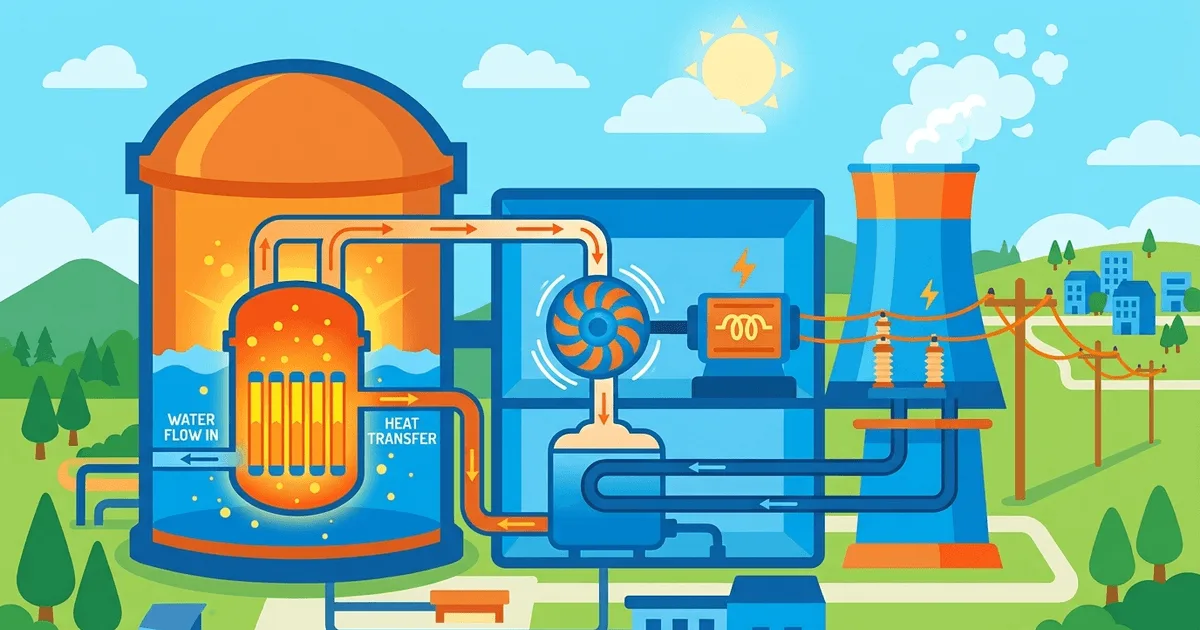
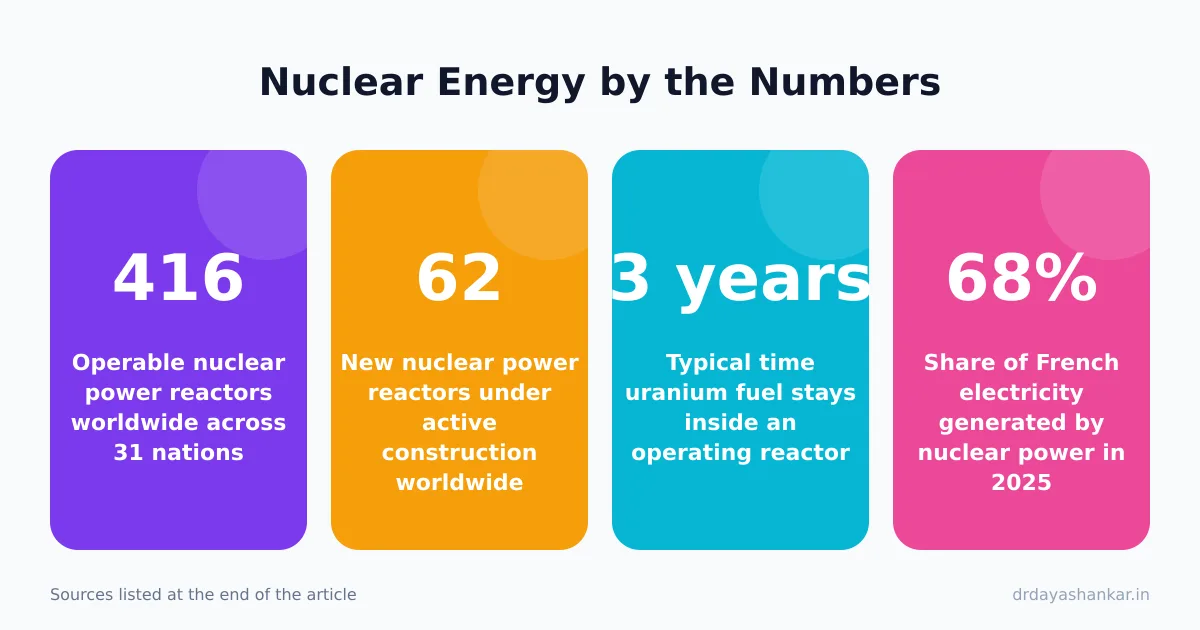
Did you know that one tiny reactor lit four bulbs in 1951 2? Today, atomic power runs whole cities across the globe. By October 2025, 416 nuclear reactors made power in 31 countries 2. Workers are building 62 more reactors now 2. Still, many people feel scared when they hear the word atomic. They picture smoke or explosions. But the reality is calm and clean. A nuclear plant is like a giant kettle. It boils water into steam to spin a big fan 2. That spinning fan makes electricity 2. Have you ever wondered how atoms spin your ceiling fan?
Think of it like this
Think of a pressure cooker on your home stove. Fire heats the water inside. Soon, hot steam pushes up with huge force. It lifts the heavy whistle. Psshh! You hear that loud rush of steam. A nuclear power plant works the same way. It does not burn coal for heat. Instead, tiny fuel atoms break apart to make heat. That hot steam pushes giant metal blades 2. That push brings bright light to your room.
What sits at the heart of the plant?
At the center of every plant sits the nuclear reactor core 2. Think of the core as a safe home for fuel. The plant uses a heavy metal called uranium for fuel 1, 2. People find natural uranium in rocks and sea water 2. Mined uranium has two main forms, called isotopes 2. Isotopes are twin atoms with different weights. Most of it is uranium-238, which makes up about 99.3 percent 2. A tiny slice is uranium-235, which is only about 0.7 percent 2.
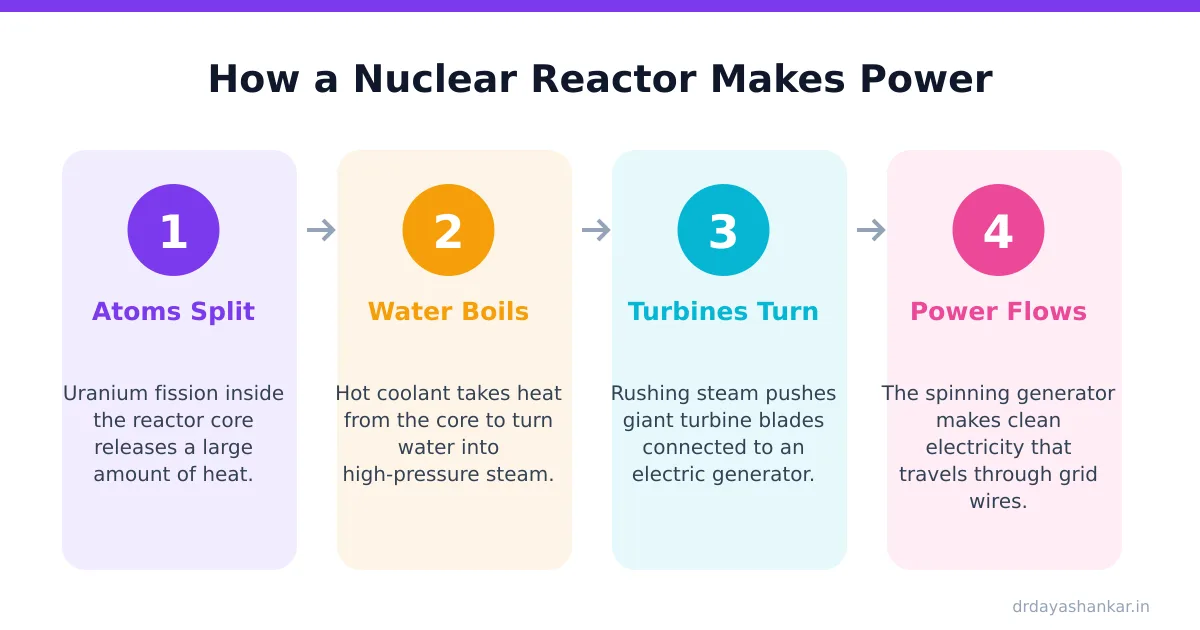
When the plant runs, uranium atoms split into two smaller atoms 1. We call this splitting nuclear fission 1. When these atoms split apart, they release a large amount of heat 1. In my work as a nuclear physicist, I teach students how careful shape guides this energy. Today, fission only happens when reactor parts are arranged properly 1. It gives us steady heat night and day without smoke.
How does split fuel turn into electricity?
Heat alone cannot light up your room. The plant must change heat into motion. This is how nuclear power plant works as a thermal power station 2.
First, heat from fission warms a liquid called coolant 2. Coolant carries heat away from the hot core 2. This coolant can be pure water, gas, or even liquid metal 2. In pressurized water reactors, hot coolant travels to a steam generator 2. There, it boils fresh water to make high-pressure steam 2. In boiling water reactors, steam forms right inside the reactor 2.
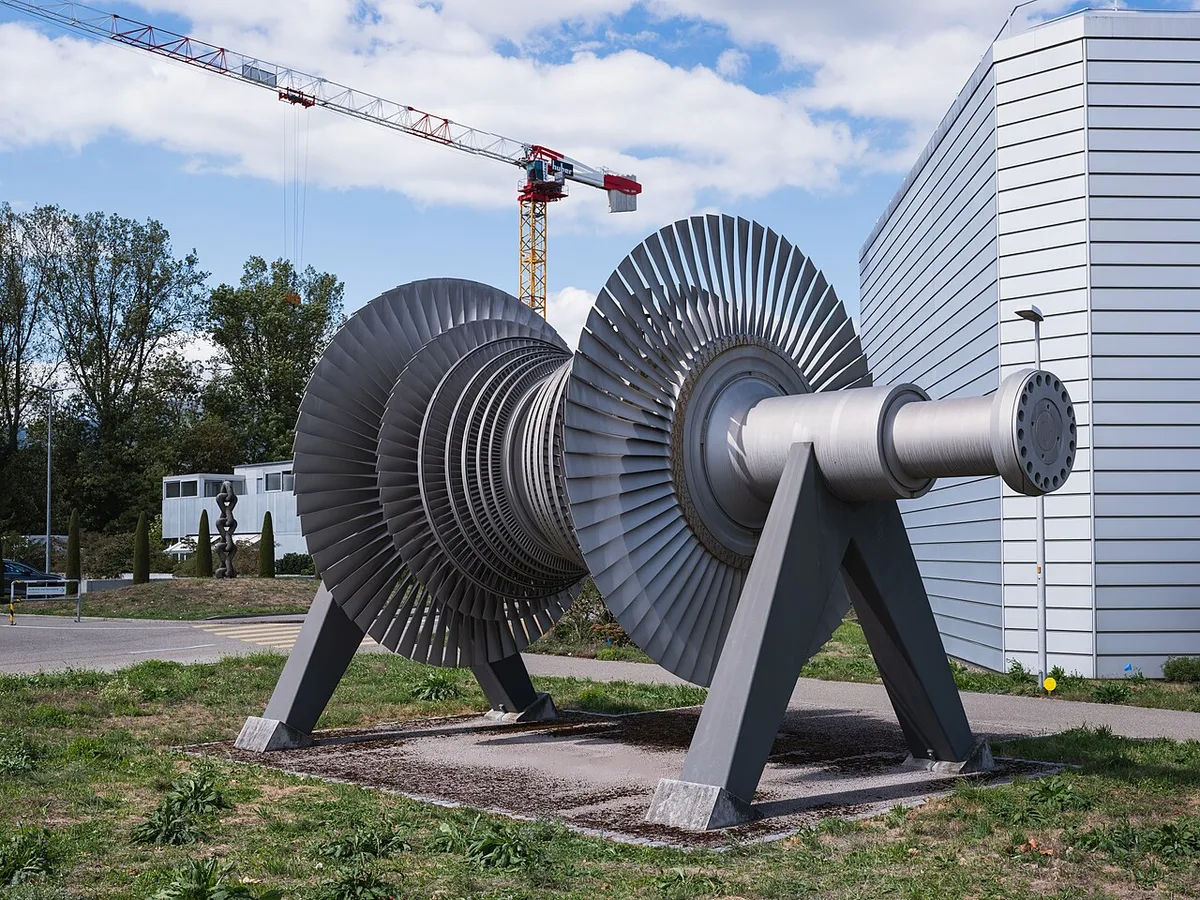
Next, trapped steam rushes out with great force 2. It hits the blades of a giant steam turbine 2. A turbine is a big wheel with curved metal blades 2. The rushing steam makes the turbine spin very fast 1, 2. The turbine turns an electrical generator 2. That spinning motion creates clean electricity for the power grid 1, 2.
Where does the hot steam go next?
After pushing the heavy blades, the steam cools down and expands 2. It enters a cooling room called a condenser 2. A condenser is a metal box that cools hot gas into water 2. Cold water from a river or cooling tower chills the pipes 1, 2. The steam turns back into cool water drops 2. Strong pumps then push that water back to the heater 2. Some plants use tall cooling towers to remove heat 1.
What happens to the fuel rods over time? Splitting fuel produces new atoms that are strongly radioactive 1. Uranium fuel usually stays inside the core for three years 2. Fuel is removed when neutron-absorbing atoms build up and stop the chain reaction 2. Workers shut down reactors when replacing old fuel with new fuel 1. They cool used fuel in deep water pools on site 2. Teams follow strict rules like nuclear-grade validation to keep every step safe.
What is new in 2026?
Nuclear technology is taking major steps forward right now. In December 2025, China began commercial operation of the Chaotan One facility in Guizhou 6, 7. This 2 by 15 megawatt plant uses a closed Brayton cycle with supercritical carbon dioxide 7, 8. It replaces traditional steam turbines with special hot gas 7, 8. This fresh method reaches much higher thermal efficiency 7, 8. It also cuts the turbine size by half 7, 8.
Exciting news also arrived in early 2026. In March 2026, the United States Nuclear Regulatory Commission issued its first commercial construction permit for an advanced non-light-water reactor 10. They gave it to TerraPower for the Kemmerer Unit 1 plant in Wyoming 10.
This plant pairs a 345 megawatt sodium-cooled fast reactor with molten-salt heat storage 10. It can boost output to 500 megawatts during peak grid hours 10. Modern reactors are becoming smaller, safer, and more flexible for power grids.
Why does nuclear power matter for India?
Our cities and villages in India need steady power every single day. We charge phones, pump water, and run trains. Solar panels help our country a lot. But solar power has a very low capacity factor compared to nuclear power 3. Solar power also needs backup power or costly energy storage to run whole cities 3.
Nuclear power plants provide steady base load generation 2, 3. Base load power means continuous electricity that flows day and night without stopping. Nuclear plants need less maintenance and run for long stretches before refueling 3. Look at France. In 2025, nuclear power made about 68 percent of all French electricity 4. That lowered French emissions to 85 grams per unit, far below the world average of 438 grams 4.
In my nuclear to healthcare journey, I saw how first principles solve big problems. Nuclear plants have a carbon footprint comparable to solar farms 2. They keep our air clean.
Key takeaways
- A nuclear plant splits uranium atoms to create steady heat without burning fuel 1.
- Hot coolant carries heat from the core to turn water into steam 2.
- High-pressure steam spins heavy turbine blades to generate electricity 1, 2.
- Nuclear plants make reliable baseload power with very low carbon emissions 2, 3.
- New designs from 2025 and 2026 use molten salt and dense gas for better efficiency 7, 10.
Words to know
- Nuclear Fission
- The splitting of a heavy atom into smaller parts to release heat 1.
- Uranium-235
- A natural type of uranium that makes up about 0.7 percent of mined rock 2.
- Reactor Core
- The strong central room in a plant where fuel atoms split 1, 2.
- Steam Turbine
- A machine with metal blades that spins fast when pushed by hot steam 2.
- Base Load Generation
- Steady electric power that runs day and night without stopping 2, 3.
Frequently asked questions
Can a nuclear power plant explode like an atomic bomb?
A nuclear power plant operates very differently from a bomb. Natural uranium contains only about 0.7 percent uranium-235 2. Inside a reactor, fission only happens when reactor parts are arranged properly 1. The plant uses heat from fission to boil water, spin a turbine, and generate electricity 1, 2.
What is the main job of plant cooling towers?
Cooling towers help remove heat produced by the nuclear reactor 1. After steam drives the turbine, a condenser cools the vapor back into water 2. The condenser transfers extra heat to a cooling tower or river 2. Pumps then send the cooled water back to create fresh steam 2.
How long does nuclear fuel stay inside the reactor?
Uranium fuel usually stays inside the reactor core for about three years 2. Over time, neutron-absorbing atoms build up and stop the chain reaction 2. Workers must shut down the reactor to replace old fuel with fresh fuel 1, 2. The used fuel cools in water pools on site 2.
How does nuclear energy help fight climate change?
Nuclear power plants generate electricity without burning fossil fuels like coal or natural gas 2. Their carbon footprint is comparable to solar and wind farms 2. In France, heavy nuclear use has kept electricity emissions at just 85 grams of carbon dioxide per kilowatt-hour, well below global averages 4.
Sources and how this was researched
Every fact above is linked to one of these sources. Numbers in boxes (like 1) point to the list below. Photo: Christian David / CC BY-SA 4.0.
- Nuclear power plant. Simple English Wikipedia.
- Nuclear power plant. Wikipedia.
- Economics of nuclear power. Wikipedia.
- Nuclear power in France. Wikipedia.
- December 2025 — China National Nuclear Corporation (CNNC) / Nuclear Power Institute of China (NPIC):** Began c. smallwarsjournal.com (2026).
- December 2025 — China National Nuclear Corporation (CNNC) / Nuclear Power Institute of China (NPIC):** Began c. cnnc.com.cn (2026).
- This marks the first commercial deployment of a closed Brayton cycle using supercritical carbon dioxide ($\tex. youtube.com (2026).
- March 2026 — U.S.. energy.gov (2026).