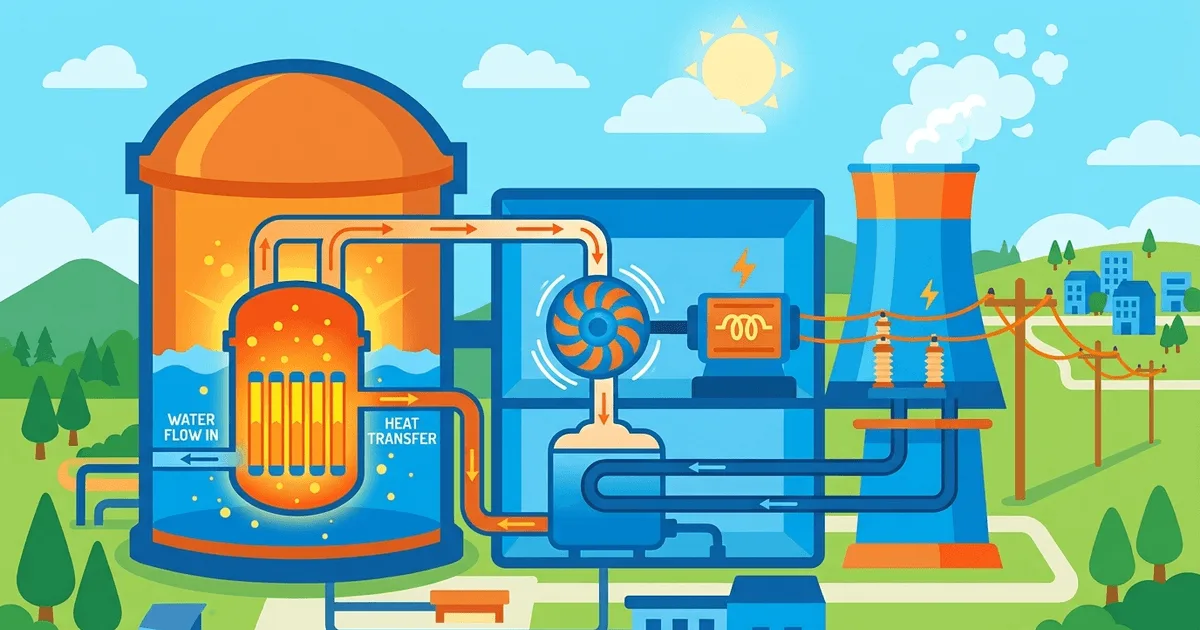
What Building Nuclear Reactor Models Taught Me About Debugging SaaS in Production

In nuclear engineering, there is no such thing as a "harmless little edge case."
During my doctoral research at IIT Guwahati, my daily life revolved around simulating thermal hydraulics and solving coupled systems of non-linear partial differential equations describing neutron transport inside nuclear reactor cores. When you model the boundary layer of fuel assemblies or compute void fraction transients under fluctuating power densities, a single rounding error or an unhandled numerical divergence does not merely trigger an unhandled exception: on paper, it represents prompt criticality or catastrophic core meltdown.
That discipline changes the way your brain is wired forever. It forces you to treat every state change with deep suspicion, verify boundary conditions before running iterations, and engineer fail-safe containment barriers that guarantee system safety even when sub-components suffer violent, unannounced failures.
When I transitioned from computational nuclear physics to founding SuktiAI—building real-world production platforms like VetanFlow (statutory payroll & compliance), LexDean (higher education accreditation intelligence), and ClinicalFlow (hospital OPD OS)—most software engineers told me I was overthinking things.
"Move fast and break things," the Silicon Valley mantra preached. "Ship on Friday, patch on Monday."
Then production happened.
In this article, I want to unpack three real engineering case studies from the trenches of building and scaling SuktiAI platforms, and how the mental models of nuclear reactor containment saved our systems from catastrophic production downtime.
Case Study 1: The VetanFlow 45-Keyword Race Condition
In Indian payroll architecture, statutory compliance is a maze of moving targets. Between the Employees' Provident Fund (EPF), Employee State Insurance (ESIC), Profession Tax across 28 states, and Gratuity ceilings, wage registers vary widely between SMEs, manufacturing plants, and tech agencies.
In VetanFlow, we built an automated ingestion pipeline capable of parsing complex salary structures across PDF registers, messy Excel files, and scanned ledgers. To achieve high throughput, the parser used a rotating pool of 45 statutory regex keywords—dynamically scored according to contextual column proximity and tenant-specific salary heads.
Traditional web debugging pointed to CPU saturation or database connection pool exhaustion. But looking at the telemetry traces, database query times were sub-15 milliseconds and CPU load was hovering around 38%.
The culprit was a classic multi-tenant state contamination race condition.
To optimize performance, the keyword matching engine had been designed with an in-memory rotating array of compiled regex expressions shared across concurrent worker threads. Under low concurrency, each thread cleaned up its contextual overrides after processing. But when three large enterprise payroll batches hit the worker pool simultaneously:
- Thread A modified the active priority weights of statutory keywords in the shared memory segment.
- Thread B, processing a completely different tenant with distinct salary nomenclature, read the mutated state before Thread A had restored the default baseline.
- The contaminated regex state caused catastrophic backtracking on complex cell strings, locking worker loops and exhausting execution workers.
Nuclear Principle Applied: Deterministic Containment & Zero-Shared-State
In nuclear reactor safety, control systems are physically decoupled. The output of one sensor channel can never write to or modify the memory register of a neighboring safety channel. They are strictly immutable or strictly isolated.
We tore out the mutable rotating pool. Every worker thread was refactored to receive a completely frozen, immutable context configuration. Tenant overrides were modeled as pure functions returning fresh state envelopes. Concurrency errors dropped to absolute zero, and processing throughput surged by 3.8x without increasing server memory footprints.
Case Study 2: LexDean & Non-Deterministic LLM Schema Crashes
One of our flagship academic platforms, LexDean, helps Deans, Registrars, and Vice-Chancellors ingest thousands of pages of institutional documents—faculty publications, student-faculty ratios, institutional budgets, research grant disclosures—and generate structured compliance filings for NAAC Criteria 1 through 7 and NIRF audits.
To extract structured evidence, we pipe document chunks through advanced LLM APIs (including Google's Gemini models). The system expects a rigorous JSON schema with 24 nested properties, including proof citations, clause references, and numerical validation checks.
Anyone who has shipped Generative AI to enterprise customers knows the dirty secret of LLMs: They will eventually violate your schema, no matter how good your system prompt is.
SyntaxError: Unexpected token '}' in JSON at position 4192. The client was facing an empty screen with an unhelpful error toast. The LLM had dropped an array bracket inside a deeply nested qualitative metric and hallucinated a trailing comma.
Naive AI developers handle this by setting up retry loops. But in high-concurrency compliance workflows, sending repeated multi-thousand token prompts to third-party LLM APIs incurs severe rate limiting, explodes token costs, and spikes user latency from 3 seconds to 25 seconds.
Nuclear Principle Applied: Multi-Barrier Defense-in-Depth
Nuclear reactors rely on Defense-in-Depth: fuel cladding is barrier one; the reactor pressure vessel is barrier two; the biological containment structure is barrier three. If barrier one fails, barrier two contains the event completely transparently.
We engineered a multi-stage validation harness for LexDean:
- Barrier 1: Strict schema prompts + JSON enforcement tokens at the API gateway level.
- Barrier 2 (Deterministic AST Repair): An autonomous stream repair parser that dynamically detects truncated tokens, unescaped quote literals, and unclosed brackets without issuing upstream re-requests.
- Barrier 3 (Graceful Degradation Fallback): If a sub-clause remains irreparably malformed, the parser isolates only the corrupted node, marks it as
[Requires Manual Audit Verification], and allows the remaining 95% of the report to render with complete mathematical accuracy.
The result? LexDean has processed over 100,000 regulatory parameters across Indian universities without a single unhandled schema parsing failure reaching a client dashboard.
Case Study 3: OPD Surges & The Myth of In-Place Hot Reloads
At ClinicalFlow, our doctor-facing OPD OS has processed over 5,600+ verified prescriptions across busy outpatient clinics. In an Indian clinic with 60 patients waiting outside in 42°C heat, a doctor has roughly 90 seconds per consultation. If the application freezes or lags while dispensing medication warnings or printing an Rx, patient care stalls instantly.
Early on, like many fast-moving web teams, we deployed minor UI and backend fixes using direct in-place file synchronizations via standard script pipelines. "It's just PHP and CSS; changes take effect immediately on disk."
That assumption is a death trap at scale.
During an active 11:30 AM clinic rush, a hotfix was uploaded while dozens of active sessions were negotiating prescription validations. As new files were being written sequentially to disk, requests arrived in the microsecond window between file uploads. Script A called a function in Script B that had not yet finished writing. The result: fatal fatal-error logs and session drops.
We immediately instituted an immutable deployment pipeline:
- Atomic Symlink Switching: Releases are built into isolated timestamped release folders. Only after comprehensive health checks pass is the active document root flipped atomically via symlink.
- Zero In-Place Mutability: Production code directories are mounted as read-only. Worker processes cannot alter their own runtime files.
- Safe State Drainage: In-flight patient consultations are allowed to finish against the previous release version before worker pools gracefully recycle.
The 4 Engineering Axioms Every AI Founder Should Adopt
If you are building SaaS platforms, AI-driven automation, or enterprise software in India today, here are the four non-negotiable mental models I encourage you to adopt:
- Assume State Is Toxic Until Proven Pure: Never pass mutable state across asynchronous boundaries. If two functions touch the same object in memory without a strict locking contract, you have engineered a future 3 AM outage.
- Build Containment Around Non-Deterministic Systems: LLMs are stochastic engines. Never allow raw model output to touch your persistence layer or business logic without passing through a deterministic defensive validation envelope.
- Telemetry Is Not An Afterthought, It Is The Core Instrument Panel: In a reactor, you cannot see the core with your eyes; you rely entirely on thermocouple arrays and neutron flux detectors. In production SaaS, if you don't have millisecond-precision structured logging and health endpoints, you are flying blind in the dark.
- Respect The Gravity Of Real-World Users: Whether it is a doctor prescribing life-saving antibiotics on ClinicalFlow, an HR manager disbursing wages on VetanFlow, or a PhD scholar submitting their life's work via ScholarFlow, software is not an abstract exercise. People depend on our systems to work without excuse.
Explore Our Live Production Platforms
Built with nuclear-grade engineering discipline, deployed at scale across Indian institutions, healthcare facilities, and enterprises.
Frequently Asked Questions
How does a background in nuclear reactor physics translate to building modern SaaS products?
Nuclear reactor systems operate under extreme constraints where catastrophic failure is unacceptable and state variables are tightly coupled. In high-concurrency SaaS and generative AI systems, the failure modes (transients, concurrency race conditions, stochastic outputs) obey identical mathematical and architectural principles: failure containment, strict state isolation, and defensive redundancy.
What was the VetanFlow keyword rotation race condition?
In SuktiAI's VetanFlow payroll and compliance engine, concurrent worker threads processing SME wage registries collided when scanning 45 dynamically rotating statutory compliance keywords across a shared tenant cache. By applying immutable execution contexts and bounded state lifecycles—analogous to control rod neutron flux boundaries—concurrency anomalies were eliminated.
How does SuktiAI handle non-deterministic LLM JSON schema output failures in LexDean?
LexDean implements a dual-pass schema validation harness with a deterministic AST fallback parser. When the upstream LLM violates strict JSON schema specifications during high-concurrency university accreditation audits, the fail-safe barrier sanitizes tokens and recovers structured regulatory trees without surfacing 500 errors to the end user.