How Can Nuclear Fusion Explained Simply Power Us?
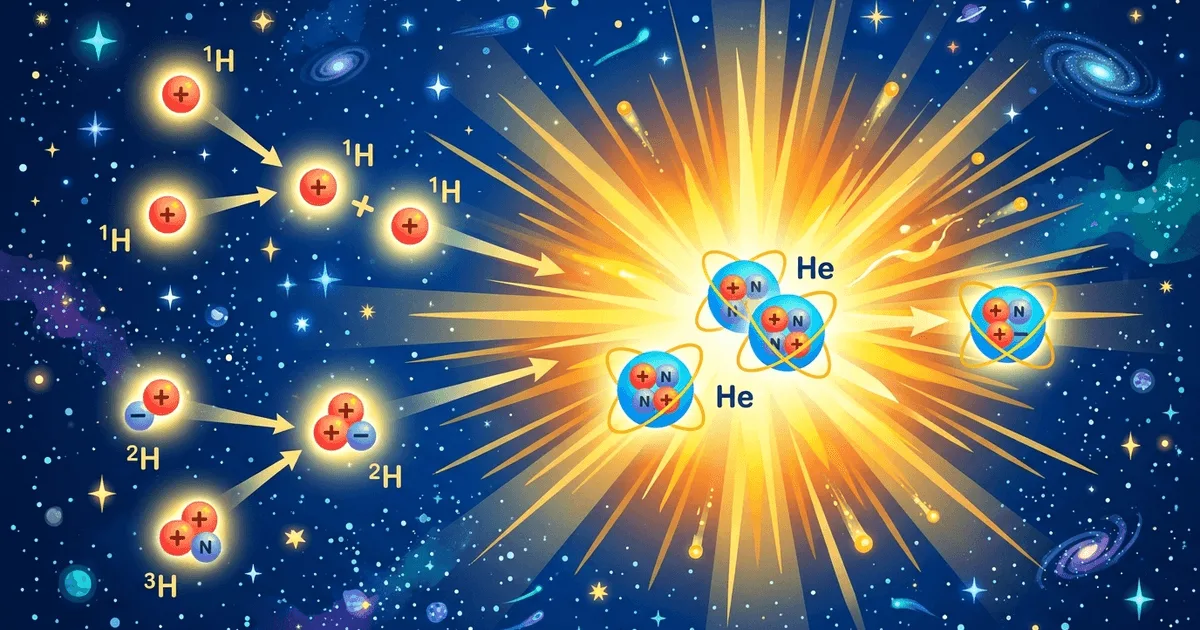
Have you ever stepped outside on a sunny day in May? You feel the hot sunlight right away. That bright warmth travels across deep space to reach your home. The Sun does not burn firewood or lump coal like an open kitchen chulha. There is no wood, oil, or smoke up in space. Deep inside its glowing core, tiny hydrogen atoms join together 2. They merge to make helium atoms 2. This natural process is called nuclear fusion 1, 2. It releases immense light and heat every single second 2. Can we build a working star here on Earth 2, 5?
Think of it like this
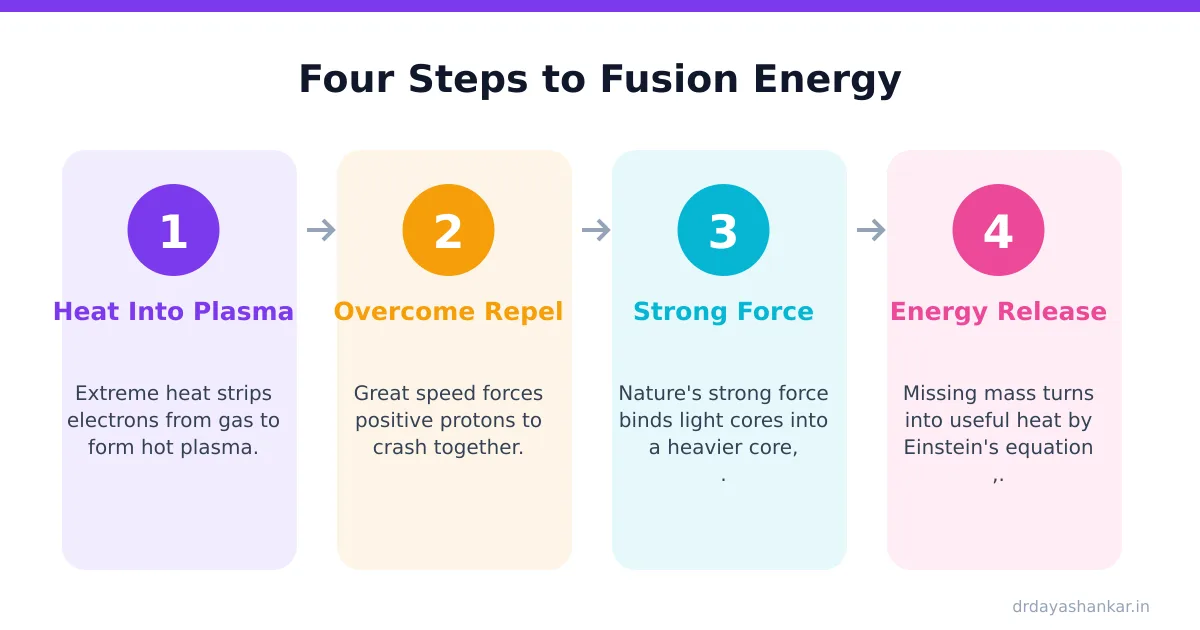
Take two toy magnets from your desk. Try to push their north poles together. They push away from each other fast 2, 3. Protons in atoms repel each other in that same way 2, 3. Now imagine you throw them together with great force. As they touch, sticky tape binds them tight. In hot stars, great speed smashes light atoms together 1, 2. A strong nuclear force then locks them in place 1, 3.
What happens inside an atom during fusion?
Let us look inside an atom. Picture a large cricket stadium in your city. The wide outer ring is like an electron cloud. Right on the center pitch sits one tiny grain of mustard seed. That seed is the nucleus 6. It is the center core of an atom 6. The core is tiny, but it holds almost all the atom's weight 6.
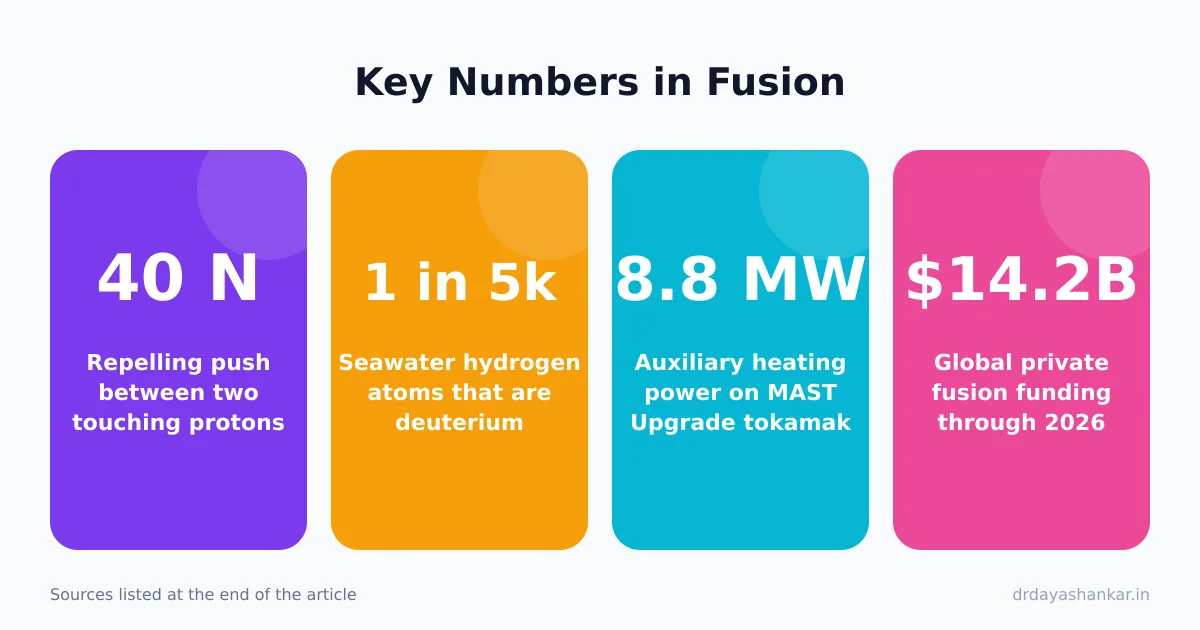
Inside this core, you find protons and neutrons 6. Protons carry positive electric charges 6. Positive charges always push away from other positive charges 2, 6. If two protons touch, they push apart with almost 40 newtons of force 3! That is a very big push for two tiny specks 3.
So why do atomic cores stay together? Nature has a strong glue called the strong nuclear force 3, 6. It pulls particles together when they get close 3. Here is nuclear fusion explained in simple words: two light cores crash together at high speed 2, 5. The strong force grabs them and forms one heavier core 1, 5.
How does our Sun squeeze atoms together?
Atomic cores push each other away with great power 2, 3. How does our Sun force them together? The secret is the giant weight of the Sun. Its gravity creates crushing pressure and heat 2, 5. It gets so hot that electrons break free from their atoms 5. This soup of bare cores and floating electrons is called plasma 5.
In 1920, Arthur Eddington predicted that stars shine by fusing hydrogen into helium 1. In 1938, Hans Bethe showed the exact reaction steps inside stars like our Sun 1. Inside the Sun's core, hydrogen cores race at wild speeds 2, 5. They crash hard and overcome their electric push 2, 5.
When these light cores join, a wonderful thing happens. The new helium core weighs slightly less than the starting pieces 1, 2. That missing mass turns straight into bright energy using Albert Einstein's famous rule 2, 3. That energy travels outward through space to warm our planet and help green crops grow.
How is fusion different from nuclear fission?
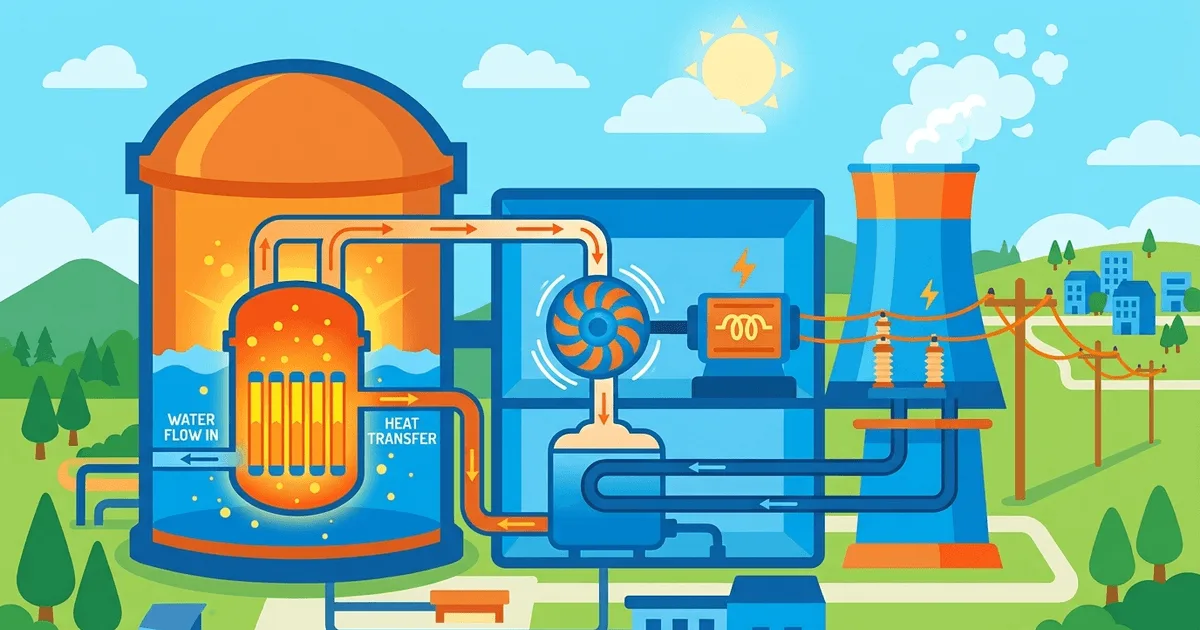
People often mix up nuclear fusion with nuclear fission. Today's commercial atomic power plants use fission 3, 5. In our guide on how nuclear power plant works, we explain how that split makes steam and electricity.
The science difference is very clear. Fission splits very heavy atoms, like uranium, into smaller parts 3, 5. Fusion does the exact opposite 1. Fusion joins very light atoms, like hydrogen, to build a heavier core 1, 5.
Fusion brings great real-world gains 5. It produces minimal high-level radioactive waste compared to fission plants 5. Fusion machines also have lower built-in safety risks 5. However, fast neutrons from fusion slowly wear down reactor walls over time 5. Tracking these materials, as discussed in from nuclear thesis to ai paper, helps scientists design better walls. Fusion offers clean power with minimal high-level radioactive waste and lower safety risks than fission 5.
What is new in fusion research in 2026?
The year 2026 brought exciting steps in fusion hardware and research funds. Global labs and private firms worked hard on new confinement tests.
In October 2026, the Fusion Industry Association reported that private fusion builders raised 4.5 billion dollars in new money over twelve months 10. That brought all private fusion funding across the world to 14.2 billion dollars 10. This total covered 56 surveyed fusion companies 10.
Machines made big steps too. In November 2026, UK engineers placed a 12-tonne double beam box on the MAST Upgrade tokamak at Culham 7. This doubled heating power to 8.8 megawatts 7. It aims for hot plasma temperatures up to 60 million degrees Celsius 7! Also in November 2026, Bengaluru startup Pranos Fusion unveiled PRAGYA, India's first private compact tokamak 8. It tests magnetic confinement physics and parts right at home 8, 9. In October 2026, Indian scientists using Aditya-L1 data also measured plasma density 11. New late 2026 tests in Culham and Bengaluru show rapid progress in fusion hardware 7, 8.
Why does fusion matter for our future lives?
Why should families, shop owners, and students care about nuclear fusion? Daily life in India runs on reliable electricity. We need power to run farm water pumps, spin ceiling fans in summer, charge mobile phones, and run trains.
Future fusion power plants plan to burn deuterium and tritium 4, 5. Deuterium is easy to find in ocean water 4. In fact, 1 in every 5,000 hydrogen atoms in seawater is deuterium 4! Tritium is rare on Earth, but reactors can make it inside lithium wall blankets when hit by neutrons 4, 5. This special fusion fuel holds huge amounts of energy 5.
You can read more about Dr. Daya Shankar and our physics work. Building full power plants is still hard because hot plasma and neutrons damage reactor walls 5. While making net electricity remains a big engineering challenge, fusion offers hope for clean, endless energy 5.
Key takeaways
- Nuclear fusion happens when light atomic cores combine into a heavier core 1, 2.
- Missing mass changes directly into energy through Albert Einstein's famous equation 2, 3.
- Crushing gravity inside stars gives the heat and pressure needed for fusion 5.
- Fusion creates minimal high-level radioactive waste compared to fission power plants 5.
- In November 2026, Bengaluru startup Pranos Fusion unveiled PRAGYA, India's first private tokamak 8.
Words to know
- Nuclear fusion
- A reaction where light atomic cores join to make one heavier core 1, 2.
- Plasma
- A super hot state of matter made of bare cores and free electrons 5.
- Strong nuclear force
- A powerful force of nature that holds protons and neutrons together 3, 6.
- Deuterium
- A heavy form of hydrogen that is found naturally in ocean water 4, 5.
- Tokamak
- A donut-shaped machine that uses magnetic fields to hold hot plasma 1, 5.
Frequently asked questions
Why does the Sun use nuclear fusion?
The Sun is very heavy. Its gravity creates crushing pressure and heat in its core 2, 5. This forces hydrogen cores to overcome repulsion and fuse into helium 1, 2. The lost mass turns into light and heat that warms Earth 2, 3.
How is fusion safer than fission?
Fusion carries lower built-in safety risks than traditional fission power 5. It makes minimal high-level radioactive waste 5. However, energetic neutrons from fusion slowly damage inside walls over time 5. Engineers are testing tough new materials to handle that wear and protect future power systems.
Sources and how this was researched
Every fact above is linked to one of these sources. Numbers in boxes (like 1) point to the list below.
- Nuclear fusion. Wikipedia.
- Nuclear fusion. Simple English Wikipedia.
- Nuclear binding energy. Wikipedia.
- Deuterium–tritium fusion. Simple English Wikipedia.
- Fusion power. Wikipedia.
- Atomic nucleus. Simple English Wikipedia.
- November 2026 — UK Atomic Energy Authority (UKAEA):** Engineers lifted and positioned a 12-tonne "double beam . world-nuclear-news.org (2026).
- November 2026 — Pranos Fusion (India):** Bengaluru-based startup Pranos Fusion unveiled **PRAGYA**, India's fi. ncaacademy.com (2026).
- The project was initiated to test magnetic confinement physics, plasma-shaping techniques, and balance-of-plan. samvaadias.com (2026).
- October 2026 — Fusion Industry Association (FIA):** The FIA's annual global report documented that private fus. world-nuclear.org (2026).
- October 2026 — Indian Institute of Astrophysics (IIA) & ISRO:** In a study published in *Astronomy & Astrophys. isro.gov.in (2026).