What Is Machine Learning? How Computers Learn
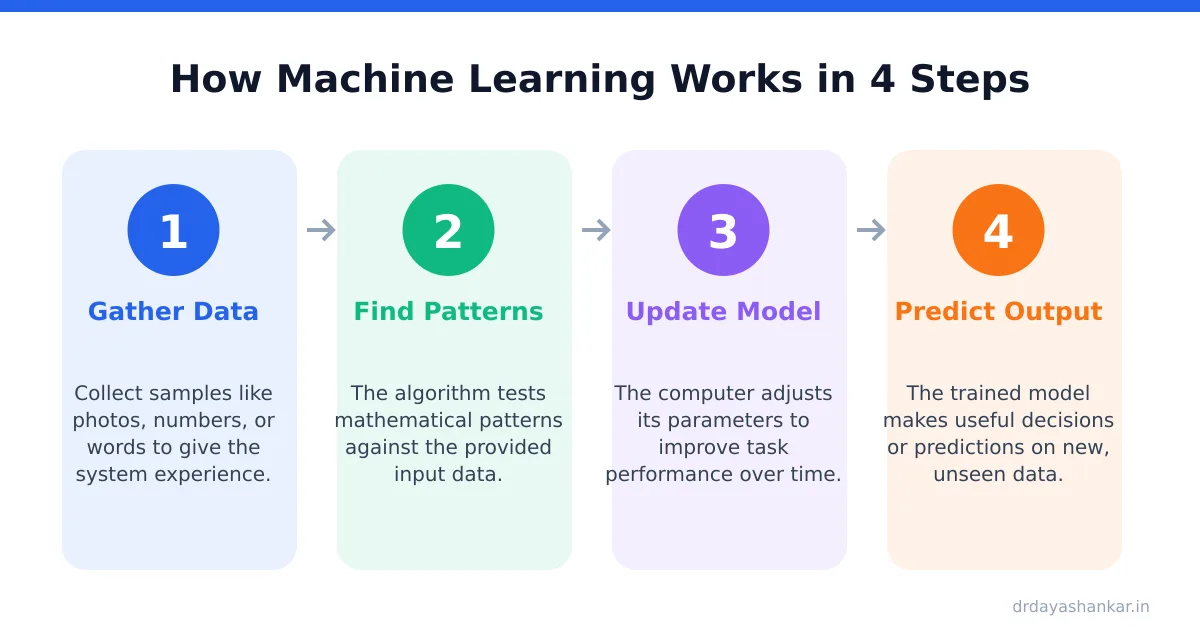
Have you ever unlocked a mobile phone just by looking at it? Or wondered how your inbox catches spam mail 1? Years ago, human coders wrote every rule by hand. To spot a cat, a coder typed rules for fur, whiskers, and paws. But what if the cat curled into a tight ball? The old code failed. In 1959, Arthur Samuel showed a better way 1, 2. He proved that computers can learn from past data on their own 2. So, what is machine learning at its heart? It is teaching computers by showing them real examples 1. The computer spots patterns to make smart predictions 1, 2.
Think of it like this
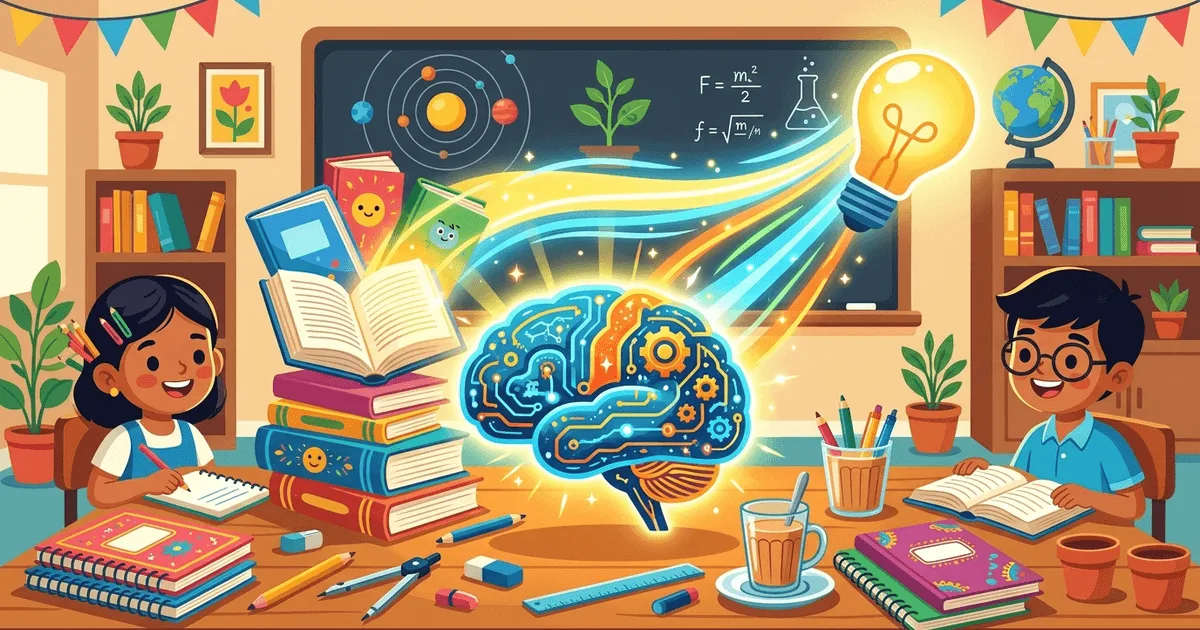
Think about brewing a hot cup of masala chai. A printed recipe gives stiff rules. That is like old software. Now think of how your grandmother cooks. She does not follow a recipe card. She smells the tea leaves. She sips a spoonful from the pan. She adds fresh ginger if it needs spice. Then she boils the milk a little longer. Machine learning works just like cooking chai by taste. The computer tests an answer. It checks its error. Then it tunes its dials until the result is spot on.
How do computers learn without hand-typed rules?
In the past, human coders had to write every step. A coder typed: "if this happens, then do that." But our daily world is messy. Think of handwriting in school notebooks. No two children write the digit five the exact same way. Writing hand-typed rules for every pencil curve is too hard.
In our look at what is artificial intelligence really, we see why machines need data. Machine learning lets a computer discover patterns by itself 1. It studies many sample files to build a working model 1. For instance, scientists use the famous MNIST dataset 1. The MNIST data has images of handwritten numbers 1. The computer studies these sample shapes 1. Soon, it learns to identify handwritten digits without human help 1.
In 1997, scientist Tom M. Mitchell gave a clear definition 2. He stated that a computer program learns if its performance on tasks improves with experience 2. With more data, its performance gets better 2.
How do machines practice and earn points?
How does a program practice its skills? It trains like a young batter facing balls in the cricket nets.
In supervised learning, we give the computer labeled cards 1, 5. We show it photos of mangoes with the name tag attached 1. Sometimes, labeling thousands of photos takes too much human time 5. In active learning, the computer asks a human expert only for tricky cases 5. This smart method saves time and speeds up training 5.
Another method is reinforcement learning 4. Here, the software acts like an agent in a game 4. We do not hand it the correct answers 4. Instead, we give it a clear goal and points 4. Good moves win high reward points 4. Bad moves lose points 4. Back in the 1960s, a machine called Cybertron used a goof button to correct bad moves 2. Software agents use rewards and action rules to master hard tasks over time 4. They try moves again and again until they win 4.
Can clever tricks fool a smart computer?
Computers do not think like human beings. They do not feel joy or pain. Machine learning models depend on statistical math and numbers 2. Because of this, models can break when data changes 6.
Scientists study these flaws in adversarial machine learning 6. In 2004, experts showed that spammers could fool filters by adding good words to spam mail 6. Later, researchers made a toy turtle that a vision model mistook for a rifle 6! Changing just one tiny pixel in a picture can fool deep models too 6. In another test, researchers stuck black tape on a speed sign 6. That tape tricked a car into driving 50 miles per hour over the limit 6.
Machine learning is widely used for optical character recognition 1. We explore this practical challenge in our look at handwritten prescription ocr systems. Spammers even added random noise into images to bypass text-reading filters 6. Tiny changes in data can trick machine learning models in surprising ways 6. We must test them with care.
What is new in 2026?
The year 2026 brought huge steps forward in physical machine learning. In the past, guiding a robot arm required rigid rules. Today, machines learn physical tasks directly from video clips.
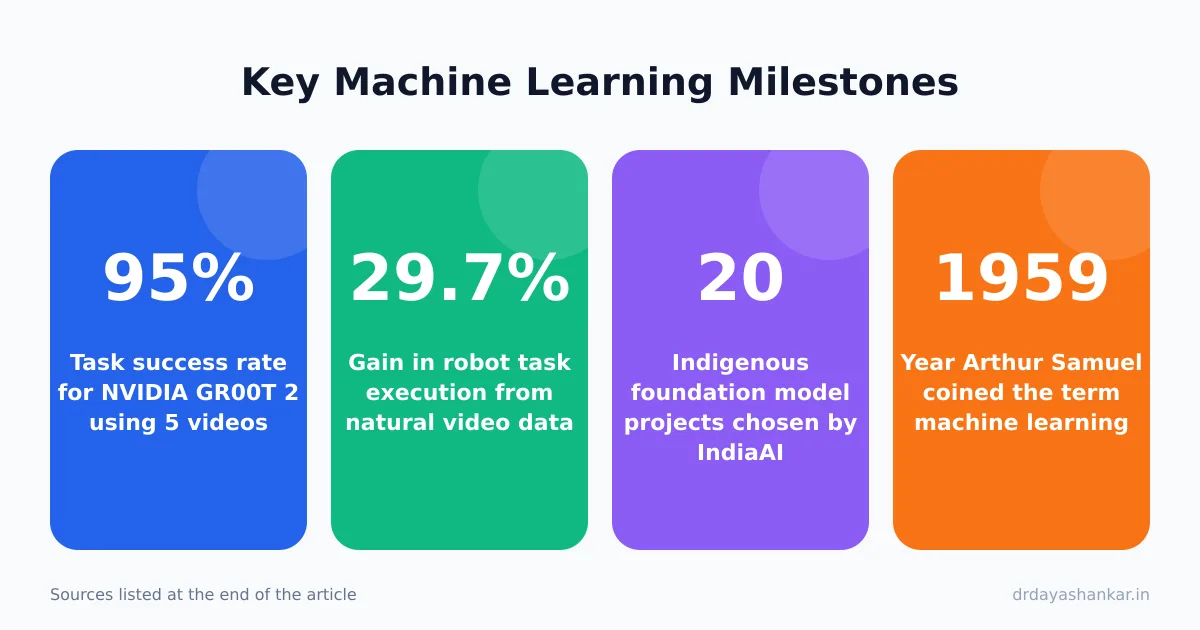
In November 2026, NVIDIA unveiled its GR00T 2 humanoid foundation model at the CoRL conference 7. The humanoid model mastered physical tasks with a 95% success rate using only 5 human video demonstrations 7. That was less than 3 minutes of training data 7! In October 2026, researchers from MIT and UIUC published a separate study on physical manipulation 10. They co-trained robot policies on 532 uncurated internet human videos totaling 28 hours 10. This method produced a 29.7% absolute gain in real-world task execution 10.
Neural network research leaped forward after Vaswani introduced the Transformer architecture in 2017 2. You can read our how chatgpt works language models guide to see how attention layers function. Today, robots watch human actions on video and learn to copy our work in the physical world 7, 10.
Why does machine learning matter across India?
Machine learning is growing very fast across India today. It helps farmers track crops, helps banks spot fraud, and supports public school classrooms.
In November 2026, the Ministry of Electronics and Information Technology (MeitY) and the IndiaAI Mission launched India's first cohort of sovereign foundation models 8, 9. These include national models named EKA-1, Dhir 2B, and Dhir 5B 8, 9. From a pool of 506 applications, the national mission selected 20 indigenous foundation model projects 9. These projects include 12 Large Multimodal Models and 8 Small Language Models 9. The teams train these models on localized Indian datasets 9.
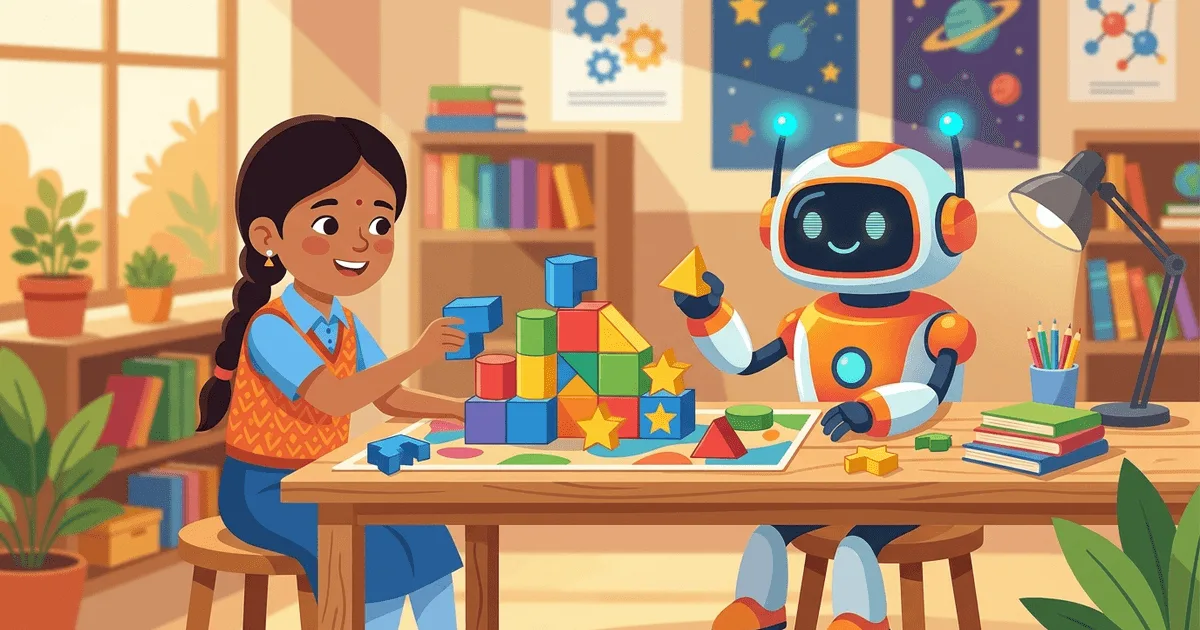
Schools are also preparing young students for tomorrow. In April 2026, the Central Board of Secondary Education (CBSE) rolled out a mandatory curriculum for Classes 3 through 8 11. It teaches pattern recognition, data-handling, and basic machine learning concepts 11. India is building home-grown models while teaching millions of school children core data skills 9, 11. The future is bright.
Key takeaways
- Machine learning lets computers find patterns in data without explicit code 1, 2.
- Arthur Samuel coined the term machine learning at IBM in 1959 1, 2.
- Systems learn using labeled examples, reward points, or active teacher queries 4, 5.
- In late 2026, humanoid foundation models learned manipulation from 5 videos 7.
- India launched twenty sovereign foundation model projects in late 2026 9.
Words to know
- Algorithm
- A set of programmed instructions that can learn and make predictions from data 1.
- Training Data
- Sample data used by a computer algorithm to build its model 1.
- Neural Network
- A statistical algorithm inspired by nerve cells that adjusts connections using data 2.
- Reinforcement Learning
- A method where software learns by receiving reward signals for its actions 4.
- Adversarial Machine Learning
- The study of attacks on learning algorithms and defenses against them 6.
Frequently asked questions
Is machine learning the same as artificial intelligence?
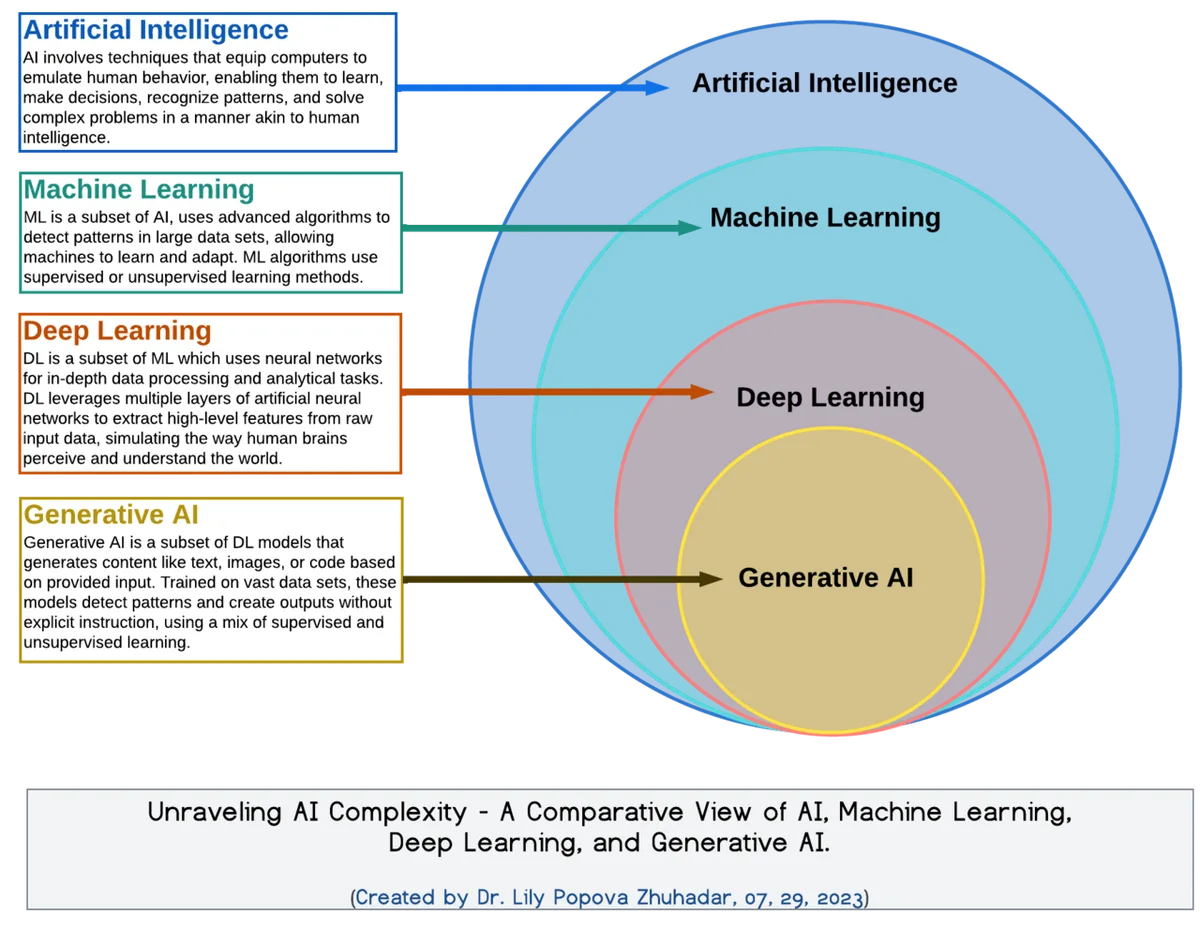
No, they are not the same thing 2. Artificial intelligence is the broad study of machines performing human-like tasks 3. Machine learning is a subfield of computer science inside AI 1. It uses statistical algorithms to learn from data without explicit hand coding 2.
Can a computer learn without human answers?
Yes, computers can learn without correct answer labels through reinforcement learning 4. The software agent interacts with an environment 4. It chooses actions and receives reward points 4. By aiming for higher rewards, it learns winning strategies over time 4.
Why do smart computer models make silly mistakes?
Computers rely on statistical distributions in data rather than conscious human thought 2, 6. If an image changes slightly, the pattern breaks 6. Even altering one pixel or adding tape can fool models 6. Fabricated data easily misleads algorithms 6.
When do Indian school students learn machine learning?
Children can learn very early now. In April 2026, the CBSE board rolled out a mandatory curriculum for Classes 3 through 8 11. This program teaches pattern recognition, data-handling, and machine learning concepts to millions of students across India 11.
Sources and how this was researched
Every fact above is linked to one of these sources. Numbers in boxes (like 1) point to the list below. Photo: Lily Popova Zhuhadar / CC BY-SA 4.0.
- Machine learning. Simple English Wikipedia.
- Machine learning. Wikipedia.
- Artificial intelligence. Wikipedia.
- Reinforcement learning. Simple English Wikipedia.
- Active learning (machine learning). Wikipedia.
- Adversarial machine learning. Wikipedia.
- November 2026 – NVIDIA:** Unveiled its **GR00T 2** humanoid action-and-world foundation model at the CoRL conf. observatorioblockchain.com (2026).
- November 2026 – Ministry of Electronics and Information Technology (MeitY) / IndiaAI Mission:** Launched India. drishtiias.com (2026).
- November 2026 – Ministry of Electronics and Information Technology (MeitY) / IndiaAI Mission:** Launched India. pib.gov.in (2026).
- October 2026 – MIT & UIUC:** Published research (*Li et al.*) establishing how robots can learn complex physic. illinois.edu (2026).
- April 2026 – Central Board of Secondary Education (CBSE), India:** Officially notified and rolled out a mandat. pib.gov.in (2026).