What Is Artificial Intelligence, Really?

Have you ever asked your phone to play a song? Have you watched a computer play chess on a screen? In 1997, a chess computer named Deep Blue beat Garry Kasparov 2. Kasparov was the world chess champion 2. Today, your phone can recognise your spoken voice or unlock when it spots your face. Smart cars can steer through city streets without a driver holding the wheel. But what is artificial intelligence behind that glowing screen? Is a tiny living brain hidden inside the machine? No, there is no magic here. These smart machines are not alive. AI is computer code running on chips. It takes in facts, spots patterns, and solves tasks. It helps people finish hard, repetitive chores much faster.
Think of it like this
Think of a young child learning to play cricket in the street. On the first day, the child misses the ball completely. But after facing hundreds of balls, the child spots the bounce and swings true. Artificial intelligence learns patterns just like that cricket batter. The software is never alive. It simply studies large piles of past examples. With enough practice data, the computer learns to handle new tasks on its own.
Can a machine really think like a human?
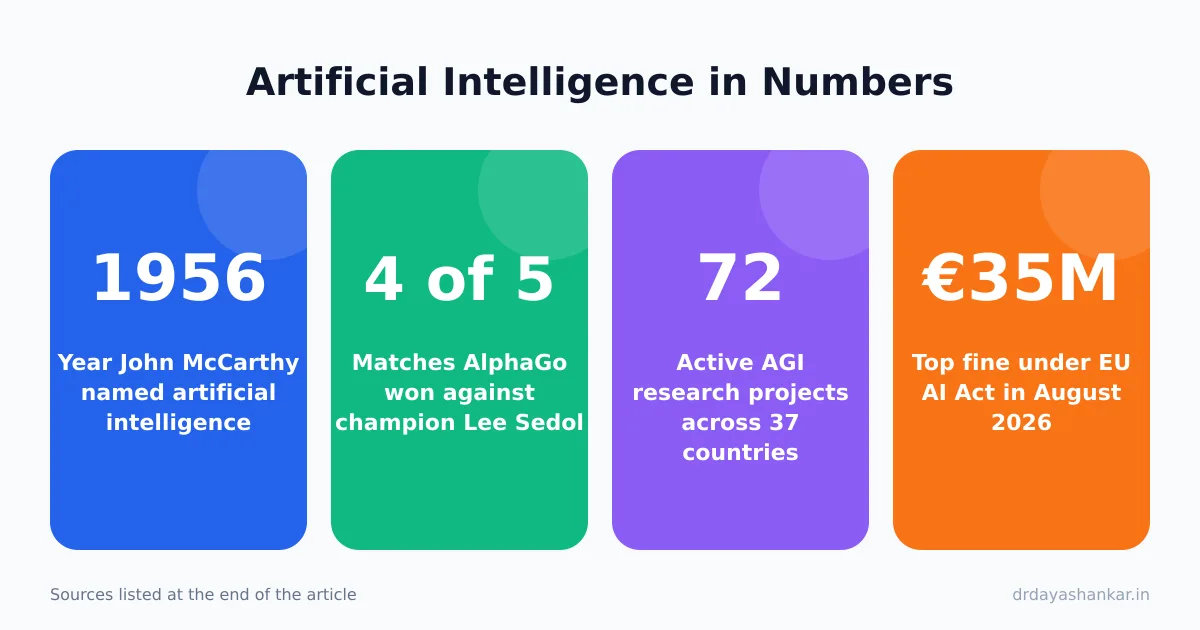
Computers do not feel happy, angry, or sad like people do. They do not get tired after doing long math problems. Early researchers wrote step-by-step rules to solve puzzles 1. An algorithm is like a cooking recipe for a computer 1. It tells the machine what steps to take in order 1. In 1956, John McCarthy gave this research field its name: artificial intelligence 2. That same year, scientists met at Dartmouth College 2. They wrote programs that could play checkers and solve word problems 2. Today, AI is a broad science field 1. It brings together math, computer code, and engineering 1. It helps machines study their world and finish goals 1.
Yet machines do not possess human minds or true feelings. On my About Dr. Daya Shankar page, I share my passion for teaching real science clearly. AI uses math and data to find practical answers. It calculates very fast, but it cannot feel joy, pain, or love like you. It simply works with math and numbers on tiny silicon chips. When you speak to a machine, it parses your voice sounds into numbers and searches for matching answers.
How does a computer actually learn from data?
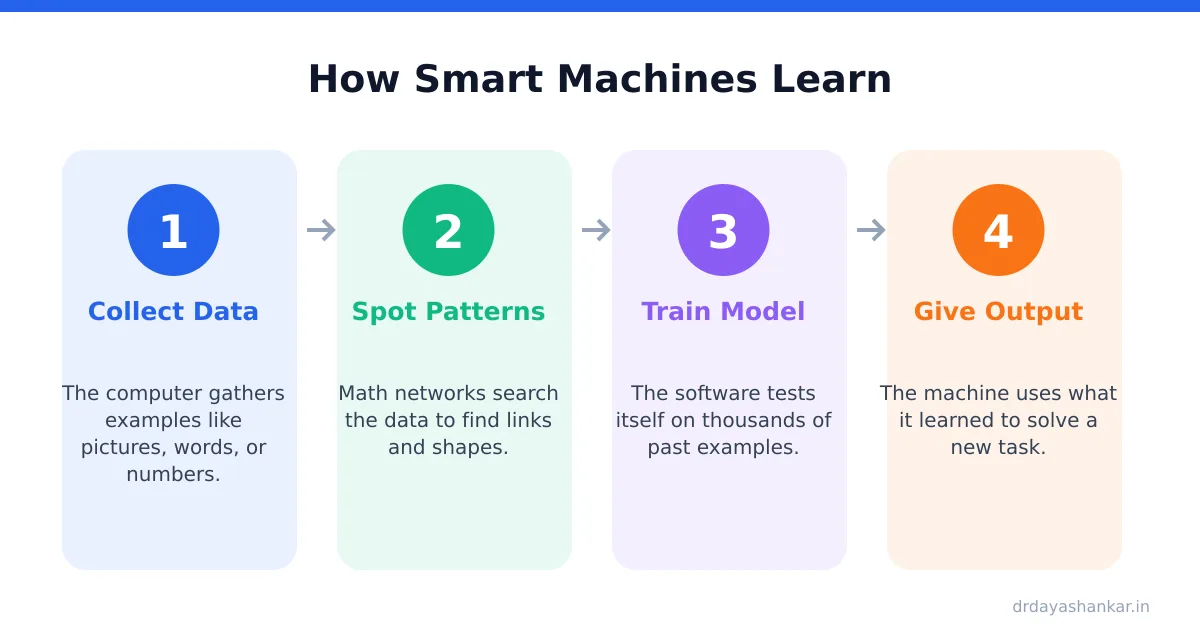
Old computer programs only did what a coder wrote down by hand. If a rule was missing, the software stopped completely. Machine learning changed that whole path 1, 2. Machine learning lets a computer learn rules directly from data 1, 2. Data means collections of facts, words, numbers, or photos. Scientists build tools called artificial neural networks 1, 2. These artificial networks are math webs loosely inspired by living animal brains.
After 2012, fast graphics chips called GPUs sped up these networks 1. Deep learning quickly overtook older computer methods at seeing images and understanding sounds. In 2017, scientists built a new tool called the transformer 1. This clever design boosted how computers handle language. Generative AI uses these tools to create new content 3. It studies piles of text, audio, and art to produce fresh pictures, music, or essays 3. Today, computers use these deep learning steps to read speech, drive cars, and sort hospital charts. These smart systems keep improving by studying more examples every day.
What is the difference between narrow AI and general AI?
Almost every AI system working in the world right now is narrow AI. Narrow AI is built to do one single job well 4, 5. For example, a program named AlphaGo beat top player Lee Sedol in 2016 2. It won four out of five games of Go 2. Yet AlphaGo cannot brew morning chai or drive a train. Narrow AI systems are confined to well-defined tasks and cannot handle other problems without new programming 5.
Researchers also study artificial general intelligence, called AGI 1, 4, 5. AGI means a computer that can do most human cognitive tasks 4, 5. In 2020, a survey found 72 active AGI projects across 37 countries 4, 5. Teams at OpenAI, Google DeepMind, and Meta work on this goal 1, 5. Building safe tools takes great care, as shown in how healthcare ai consulting helps care clinics safely. Today, AGI remains an unproven idea 5. Experts disagree on when human-level AI might arrive 4. Some think it will take decades, while others think it may never happen at all 4.

What is new in 2026?
The year 2026 brought landmark rules and major global meetings for artificial intelligence. On August 2, 2026, the European Union began enforcing its landmark Artificial Intelligence Act 7. The EU created the first legally binding definition of an AI system 7. The law clearly separates smart, adaptive systems from standard software 7. If a company breaks these rules, it faces fines of up to 35 million euros or 7 percent of its global annual turnover 7. This rule protects people from harmful, unsafe software tools 6, 7.
India also stepped forward on the global stage. In February 2026, the Indian government hosted the India AI Impact Summit in New Delhi 10. The summit brought together delegations from over 30 countries and 20 heads of state 10. It gathered 300 exhibitors and passed the New Delhi Declaration 10. This was the first major AI summit hosted by the Global South 10. The declaration defined AI as an instrument for inclusive growth and public infrastructure for everyone 10.
Why does artificial intelligence matter for India and your life?
Artificial intelligence is not just tucked away in big science laboratories. It touches your daily routine across India right now. Banks use smart systems to spot odd charges and keep family savings safe. In hospitals, AI helps doctors spot illnesses and choose proper treatments 2. You can read more about this in solving india doctor patient ratio ai clinics.
Clever computer programs run quietly right inside your pocket mobile phone. Voice assistants help you set morning alarms, find road directions, and note down chores. Language tools translate words between English, Hindi, Tamil, and Bengali so families stay connected. Video games use AI to build responsive characters that react to your choices 2. Creative software helps students draft essays, helps artists sketch pictures, and helps programmers fix broken code. These helpful programs can save busy people hours of tedious effort.
Here are key ways smart software helps people in daily life:
- Catching bank card tricks before money is lost.
- Helping doctors inspect scans to treat patients early 2.
- Guiding road maps and electric vehicles through heavy city traffic.
- Translating regional languages so different Indian communities talk easily.
Key takeaways
- Artificial intelligence is computer software that studies data to solve human-like tasks 1, 2.
- Scientist John McCarthy coined the term artificial intelligence during a 1956 conference 2.
- Fast graphics chips and neural networks drove rapid growth in deep learning after 2012 1.
- Current tools use narrow AI, while human-level general AI remains an unproven goal 4, 5.
- In August 2026, the European Union began enforcing global penalties under the AI Act 7.
Words to know
- Algorithm
- A clear list of step-by-step instructions that a computer follows in order.
- Neural Network
- A math web loosely shaped like brain cells that spots patterns in data.
- Narrow AI
- A computer program built to perform only one specific task well.
- Generative AI
- Software that studies past examples to create new text, art, or audio.
- Machine Learning
- A method where computers learn rules directly from data instead of hand coding.
Frequently asked questions
Is artificial intelligence alive or able to feel emotions?
No, artificial intelligence is not alive, and it has no feelings. AI systems are clever sets of math rules running on computer chips. Generative AI can create sentences or draw artwork, but it cannot think for itself 3. It does not have feelings, personal beliefs, or a conscious beating heart.
Who came up with the name artificial intelligence?
Scientist John McCarthy came up with the name in 1956 2. That summer, researchers met at Dartmouth College for a month-long brainstorming session 2. They wrote early programs to play checkers and solve word problems 2. That famous meeting founded AI as a formal science discipline 1, 2.
What is the main difference between AI and machine learning?
Artificial intelligence is the broad scientific goal of making machines solve smart tasks 1. Machine learning is one practical way to reach that goal 1, 2. Instead of coders writing every rule by hand, machine learning enables software to study example data and learn patterns directly 1, 2.
Can artificial intelligence replace human doctors in hospitals?
No, artificial intelligence cannot replace real human doctors. AI assists doctors by scanning medical images, spotting diseases early, and finding helpful treatments faster 2. Narrow systems can assist human caregivers, but machines lack medical common sense, human empathy, and personal responsibility. Always consult a licensed doctor for care.
Sources and how this was researched
Every fact above is linked to one of these sources. Numbers in boxes (like 1) point to the list below. Photo: Photo by David J. Stang / CC BY-SA 4.0.
- Artificial intelligence. Wikipedia.
- Artificial intelligence. Simple English Wikipedia.
- Generative artificial intelligence. Simple English Wikipedia.
- Artificial general intelligence. Simple English Wikipedia.
- Artificial general intelligence. Wikipedia.
- Artificial Intelligence Act. Wikipedia.
- August 2026 – European Union Enforces Landmark AI Regulatory Definitions:** The EU Artificial Intelligence Act. europa.eu (2026).
- February 2026 – Government of India Hosts India AI Impact Summit:** The Ministry of Electronics and Informatio. wikipedia.org (2026).