Why Do We Get Fever? What Happens Inside Your Body

Have you ever wondered why your body gets hot when you catch a cold? When you fall ill, your forehead often feels very warm. Your family may feel worried. They might place a cool cloth on your head. You feel tired and sleepy. You lose your appetite 1. But here is a big surprise. A fever is not the disease itself 1! It is an ancient defense shield 1. Your brain sets a higher heat target to help fight off illness 1. Germs see their normal life cycles disrupted when body heat goes up 2. So why do we get fever when we fall sick? Let us explore how your body controls its inner heat dial.
Think of it like this
Think of your body as a stainless steel pressure cooker on a gas stove. When you want to boil milk or steam lentils, you turn up the flame. Heat stops tiny bugs from spoiling food. In the exact same way, your brain turns up its inner burner. It raises body heat to disrupt invading germs 2.
Who turns up the heat dial inside your brain?
Deep inside your head sits a tiny master control center called the hypothalamus. You can say it as hy-po-THAL-uh-mus. It works like the thermostat knob on an air conditioner 1. It decides how warm your body should be 1.
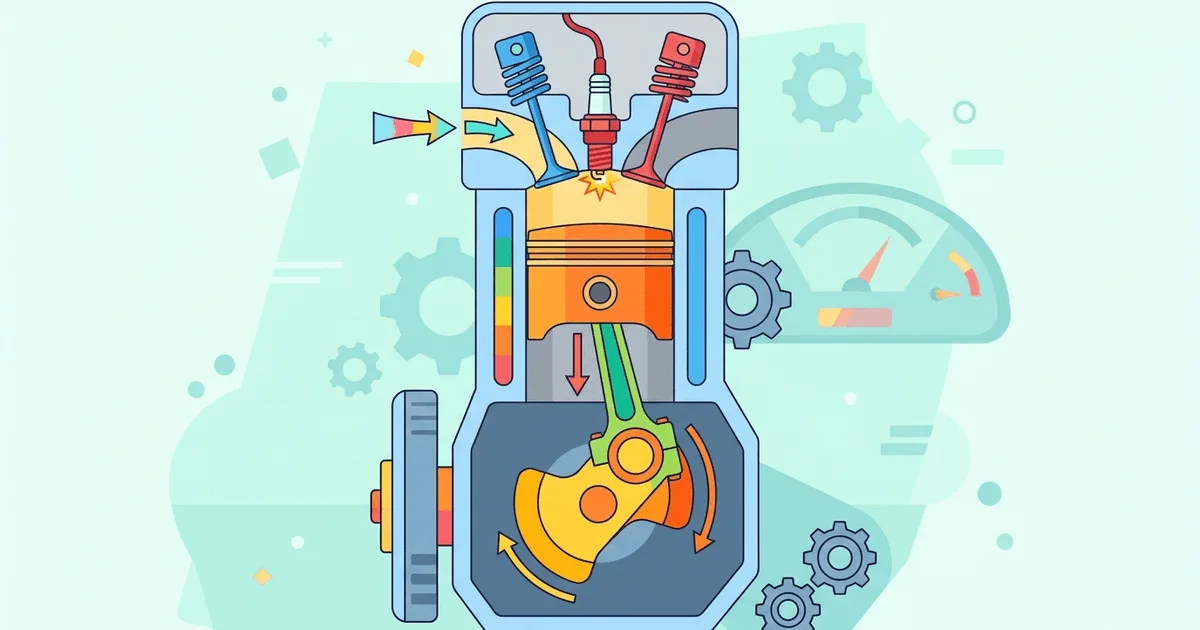
Normal body warmth varies from person to person 2. Many people think normal heat is always 37 degrees Celsius 2. Yet medical guides use values between 37.2 and 38.3 degrees Celsius as normal upper limits 1. Just like an engine manages heat in how car engine works science, your brain monitors thermal limits 1.
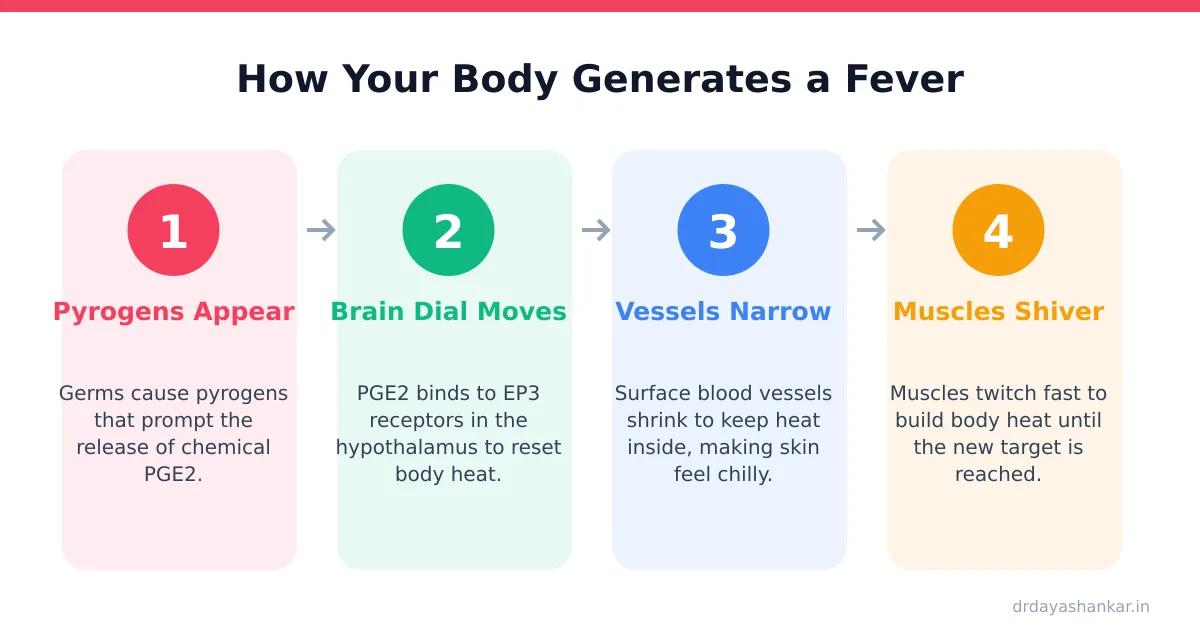
When infections strike, tiny triggers called pyrogens appear 1. Pyrogens tell your cells to make prostaglandin E2, or PGE2 1. PGE2 binds to EP3 receivers in your brain 1. This chemical signal resets your inner thermostat to a higher target 1. Your brain then orders your body to make and trap warmth 1.
Why do you feel shivering cold when your temperature rises?
Have you ever pulled two warm quilts over yourself while burning with fever? Your skin feels hot to your parents. Yet your teeth chatter like you are in cold mountain air. Why does this happen?
When your brain raises its heat target, your flowing blood is cooler than this new goal 1. Because of this gap, your brain thinks your body is cold 1! It rushes to trap and make heat 1.
First, tiny blood vessels near your skin squeeze shut 1. Doctors call this narrowing vasoconstriction 1. It keeps warm blood deep inside your core 1. Less blood reaches your skin, so your hands feel chilly 1.
Next, your brain orders your muscles to twitch fast 1. This rapid twitching is shivering 1. Shivering acts like a tiny motor that makes fast heat 1. Looking through physics first thinking why your healthcare ai fails without first principles shows how muscles burn fuel until blood matches the brain target 1.
How does extra heat help fight bad germs?
Why does your body make you feel sick and tired? Heat is a powerful tool against germs. Most sickness bugs grow fast at normal body warmth. When body heat rises, the life cycles of germs get disrupted 2.
Fever is not an error. Doctors have noted fever as a major sign of illness since ancient times 3. When heat goes up, your body wakes up protective systems to fight bugs 1, 3. This defense battles illnesses like colds, flu, and bacterial bugs 1.
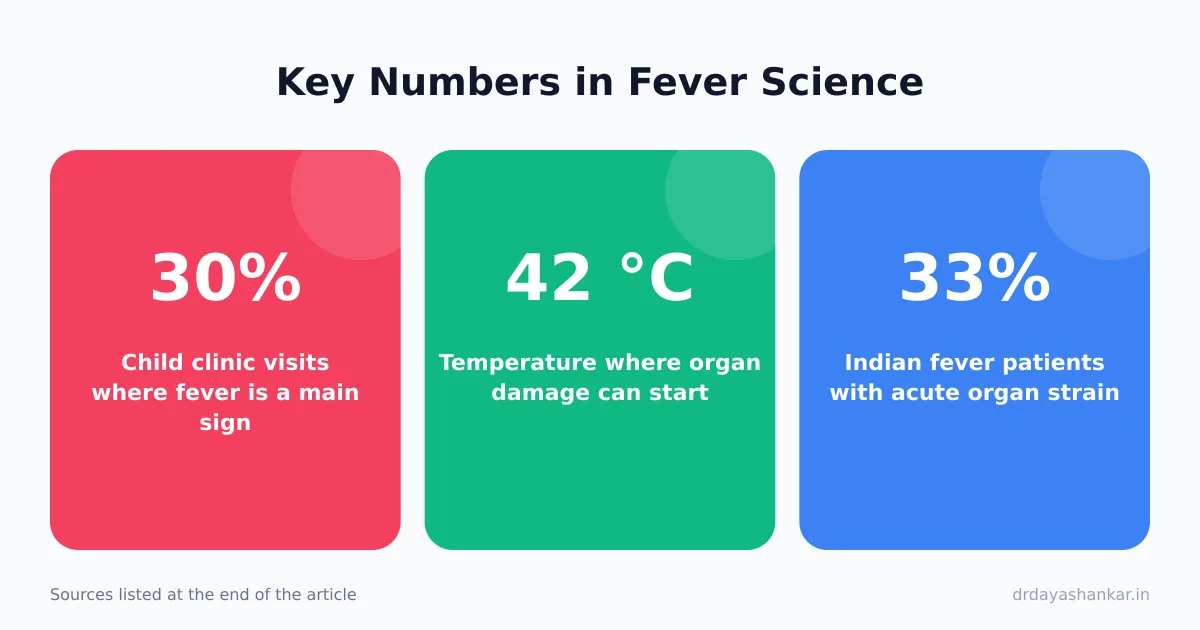
Fever accounts for about 30% of doctor visits for children 1. While fever is an evolved shield, extreme heat brings risk 1. Fevers do not typically go higher than 41 to 42 degrees Celsius 1. But at or above 42 degrees Celsius, organs can suffer lasting damage 2. Fever acts as a helpful shield, but extreme heat requires careful medical care 1, 2.
What is new in 2026 in fever science?
Scientists are finding fresh facts about how fever works. In November 2025, teams at Tongji University School of Medicine published research in Advanced Science 4. They proved that heat between 38.5°C and 40.0°C reshapes your immune response 4. They built "Engineered Fever Therapy" using tiny particles to trigger disease-fighting cells 4.
In December 2025, a study in Rockefeller University Press revealed another finding 5. Human antiviral tools called interferon-stimulated genes work best at fever temperatures rather than normal 37.0°C warmth 5. Heat boosts your natural viral defenses 5.
In February 2026, neuroscientists at Nagoya University published a study in The Journal of Physiology 6. They mapped the brain wiring of fever chills 6. They showed how PGE2 binds to EP3 receivers in the brain 6. This signal triggers shivering and warmth-seeking habits while ordering the brain to raise body heat 6. In 2026, scientists mapped the exact brain circuits behind chills and shivering 6.
Why does understanding fever matter for Indian families?
In India, many families panic when a child feels warm. Doctors call this fear "fever phobia" 1. Research shows that lowering a mild fever does not change how fast you heal 1. Fever itself is usually a normal defense sign 1.
Yet a fever can be caused by conditions ranging from mild bugs to life-threatening illnesses 1. Babies under three months or people with weak immune systems need quick medical attention 1. In March 2026, health testers at Thyrocare Technologies studied 108,324 fever patients across India 8. They found that nearly 1 in 3 patients (33%) faced acute organ strain 8. This strain was caused mainly by typhoid in 18.1% of patients and dengue in 14.4% 8. Also, 10% of patients had two infections at once 8.
Smart testing systems, seen in solving india doctor patient ratio ai, help clinics spot these bugs early. Knowing how fever works helps families stay calm while seeking prompt medical care for serious sickness 1, 8.
Key takeaways
- Your brain hypothalamus raises its set point during illness to cause a fever 1.
- Shivering happens when muscles shake quickly to raise body temperature to the new target 1.
- Higher body heat disrupts the normal life cycles of invading germs 2.
- New studies show human antiviral enzymes work best at higher fever temperatures 5.
- A March 2026 study of over 108,000 Indian patients showed 33% faced acute organ strain from bugs like dengue and typhoid 8.
Words to know
- Hypothalamus
- The small brain region that acts like a thermostat to set your body heat 1.
- Pyrogen
- A substance that triggers your body to release PGE2 and raise heat 1.
- Prostaglandin E2
- A chemical messenger that tells the brain to reset body temperature higher 1.
- Vasoconstriction
- The narrowing of surface blood vessels that keeps warm blood deep inside 1.
- Hyperthermia
- High heat from trapped heat or hard exercise rather than a brain set point change 1.
Frequently asked questions
Is a fever dangerous for young children?
Most fevers do not cause harm and help fight infection 1. Body heat rarely passes 41 to 42 degrees Celsius 1. But at 42 degrees, organs can suffer damage 2. Babies under three months need a doctor right away 1. People with weak immune systems also need medical care 1.
Why do I shiver when I have a fever?
When your brain raises its heat target, your blood is cooler than that goal 1. Your brain thinks you are cold 1. It orders your muscles to twitch quickly, causing shivering 1. This movement makes heat until your blood matches the new brain goal 1.
Sources and how this was researched
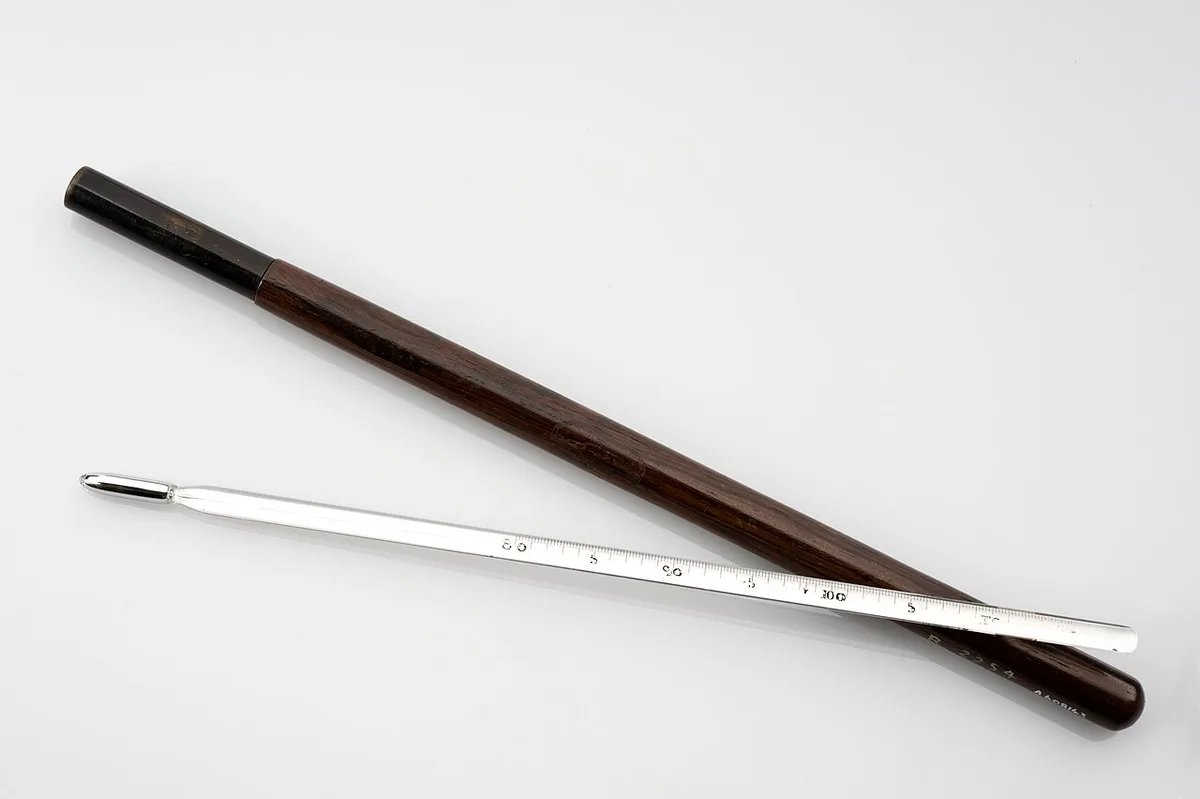
Every fact above is linked to one of these sources. Numbers in boxes (like 1) point to the list below. Photo: Unknown / CC BY 4.0.
- Fever. Wikipedia.
- Fever. Simple English Wikipedia.
- Fever, fever patterns and diseases called 'fever'--a review.. Journal of infection and public health (2011).
- November 2025 (Nanotechnology & Immune Reprogramming)** – Researchers at Tongji University School of Medicine . nih.gov (2026).
- December 2025 (Antiviral Enzyme Temperature Optimization)** – In a study published with Rockefeller University. rupress.org (2026).
- February 2026 (Neural Circuitry of Chills and Shivering)** – Neuroscientists at Nagoya University Graduate Sch. eurekalert.org (2026).
- March 2026 (Systemic Organ Stress and Coinfections in India)** – Diagnosticians at Thyrocare Technologies eval. expresshealthcare.in (2026).